Shopify SEO services are a set of technical, on-page and content tasks that help your store appear in Google for the searches your customers make, then turn that traffic into orders. A good service starts with an audit of your collections, product pages and indexing, fixes what holds the store back, and reports on rankings, organic traffic and revenue. This guide explains what is normally included, which Shopify-specific problems matter most, what UAE stores should account for, and how to choose between an agency and a company.
TL;DR
- Shopify handles the basics for you (canonical tags, sitemap, robots.txt, SSL), so specialist work focuses on structure, duplicate URLs, content and measurement.
- A proper service covers a technical audit, keyword research, on-page optimisation, content and link building, with reporting tied to revenue rather than rankings alone.
- UAE stores should check their market and language set-up, because Shopify generates hreflang tags from your Markets configuration.
- Judge an agency or company on its audit, its reporting and its understanding of Dubai and Abu Dhabi search behaviour, not on its size or its promises.
- Track clicks, impressions, average position and conversion rate in Google Search Console and GA4 from day one.
Table of Contents
- What Shopify SEO services usually include
- What Shopify already does for you
- The Shopify-specific issues a specialist looks at
- How a Shopify store ranks on Google
- What UAE stores should account for
- How to measure Shopify SEO results
- Agency or company: how to choose
- Our perspective on Shopify SEO
- Work with Foureyes Solutions
- A sensible order of work
- FAQ
- Sources
What Shopify SEO services usually include
The pages that rank for this topic describe a similar scope: technical audits, keyword research, on-page optimisation, content creation and link building are the usual headings, sometimes alongside development work. In practice, a Shopify engagement breaks down like this:
- Store audit. A review of how Google crawls and indexes your store, which pages are indexed, which are blocked, and where duplicate or thin pages exist.
- Keyword research. Mapping the terms shoppers use to the right page type: broad category terms to collections, specific product terms to product pages, questions to blog content.
- Collection and site architecture. Shopify’s recommended structure is a clear hierarchy from homepage to collections to products, with internal links and descriptive, hyphen-separated URLs, as set out in the Shopify Help Center SEO overview.
- Product and collection page optimisation. Title tags, meta descriptions, headings, image alt text and copy written for both search engines and buyers.
- Content. Buying guides, comparison pages and answers to pre-purchase questions, published through Shopify’s blog.
- Link building and brand mentions. Earning links from relevant sites, which Shopify also lists as part of ranking well.
- Measurement and reporting. Search Console and GA4 set-up, dashboards, and a monthly review of what moved and why.
If you also want visibility in AI-generated answers, ask whether the provider covers Generative Engine Optimisation alongside classic SEO. We cover that in our GEO service.
What Shopify already does for you
Before paying for work, it helps to know what the platform covers. According to Shopify, stores automatically get canonical tags, sitemap.xml and robots.txt files, theme-generated title tags that include the store name, and SSL certificates activated by default.
That is a solid foundation, and it means a good Shopify SEO service does not waste your budget on basics. The value comes from what sits on top: how your catalogue is organised, how your pages are written, how your theme and apps behave, and how well you are measured.
The Shopify-specific issues a specialist looks at
Duplicate URLs and canonical health
Shopify can serve one product through two addresses: the direct product URL and a collection-based URL. Shopify’s own audit checklist says the canonical_url object should point both versions to the direct /products/ URL. The same checklist asks you to:
- check for multiple or conflicting canonical tags added by themes, SEO apps or translation apps;
- confirm that the sitemap contains direct product URLs;
- inspect examples in Google Search Console to compare the canonical you declared with the one Google selected;
- review smart collection conditions that create nearly identical product sets.
Google’s guidance puts duplicate content in perspective: it is not a problem in itself, and Google will try to canonicalise URLs automatically if you do not. The practical point is control. When you set the canonical yourself, you decide which page collects ranking signals rather than leaving it to Google’s guess.
Where duplicates do exist, Shopify’s duplicate content guide recommends 301 redirects to consolidate pages, canonical tags on the original, and noindex for duplicates that still rank after those steps.
Collections that overlap
Smart collections are convenient, but two collections that contain nearly the same products compete for the same searches. A specialist decides which collection is the main page for a term and adjusts the rest, so one strong page is not split into several weak ones.
Themes and apps
Every app and theme change can add code. Conflicting canonical tags, duplicate schema or heavy scripts that slow pages are the usual results. Part of an audit is checking that what you have installed is helping rather than adding noise. If speed is the main concern, a platform rebuild may be worth considering, and our headless commerce case study shows how we approached mobile speed for a Dubai store.
On-page basics done properly
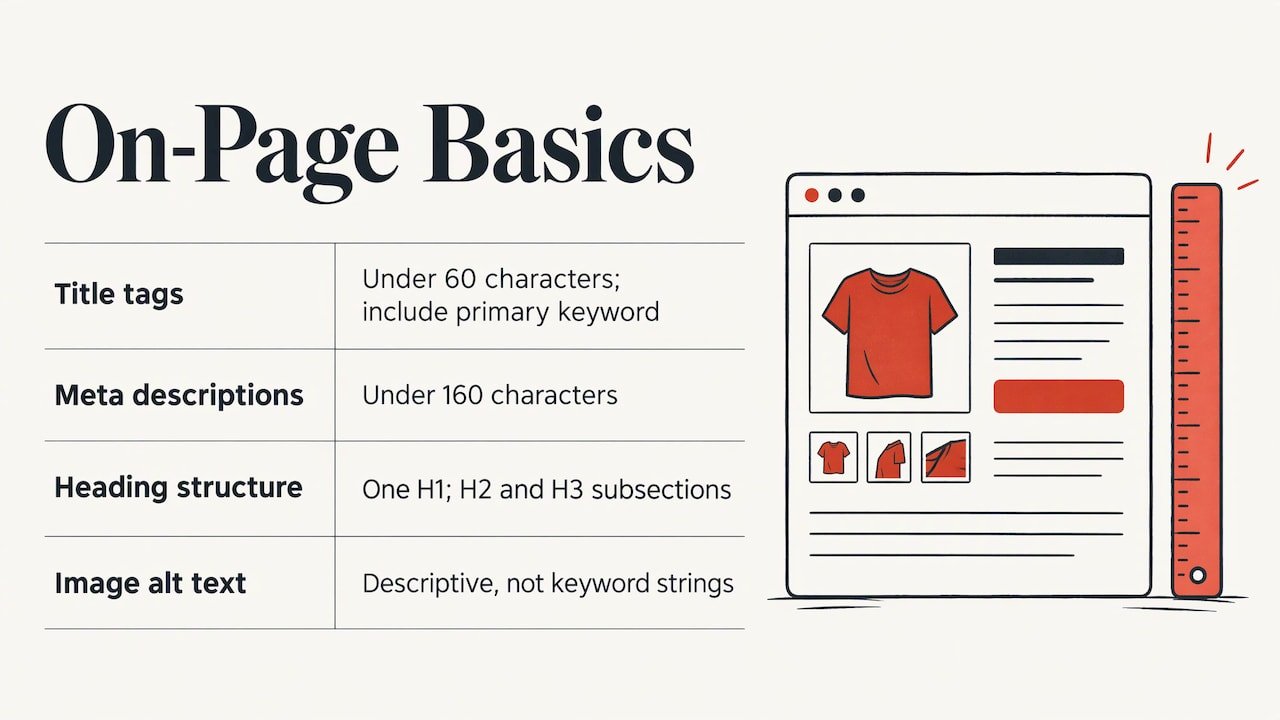
Shopify’s guidance is specific here. It recommends title tags under 60 characters that include the primary keyword, meta descriptions under 160 characters, one H1 per page with H2 and H3 for subsections, and descriptive image alt text. An example of useful alt text is a plain description such as men’s waterproof hiking boots, not a string of keywords.
This is the work that scales badly by hand. On a catalogue of hundreds of products, a service should set templates and rules, then refine the pages that earn most of your revenue.
How a Shopify store ranks on Google
The fundamentals are not secret. Shopify’s advice is to find keywords relevant to your products and brand, use them in page titles, descriptions and image alt text, make sure URLs and file names match the content, and add your full domain to Google Search Console so the store can be crawled and indexed. Shopify adds that Google indexes automatically within 48 to 72 hours after you add or update information. The same page also recommends creating relevant content and encouraging other websites to link back to you.
Google’s own starter guide makes the priority clear: sites that follow its Search Essentials are more likely to show up in results, and creating compelling, useful content will likely influence your presence in search more than any other suggestion in the guide.
For a store, useful content means:
- Collection pages that describe what is in the range, how to choose, and what makes the options different.
- Product pages with original descriptions, clear specifications, delivery and returns information, and reviews.
- Guides that answer the questions a buyer asks before purchase.
What UAE stores should account for
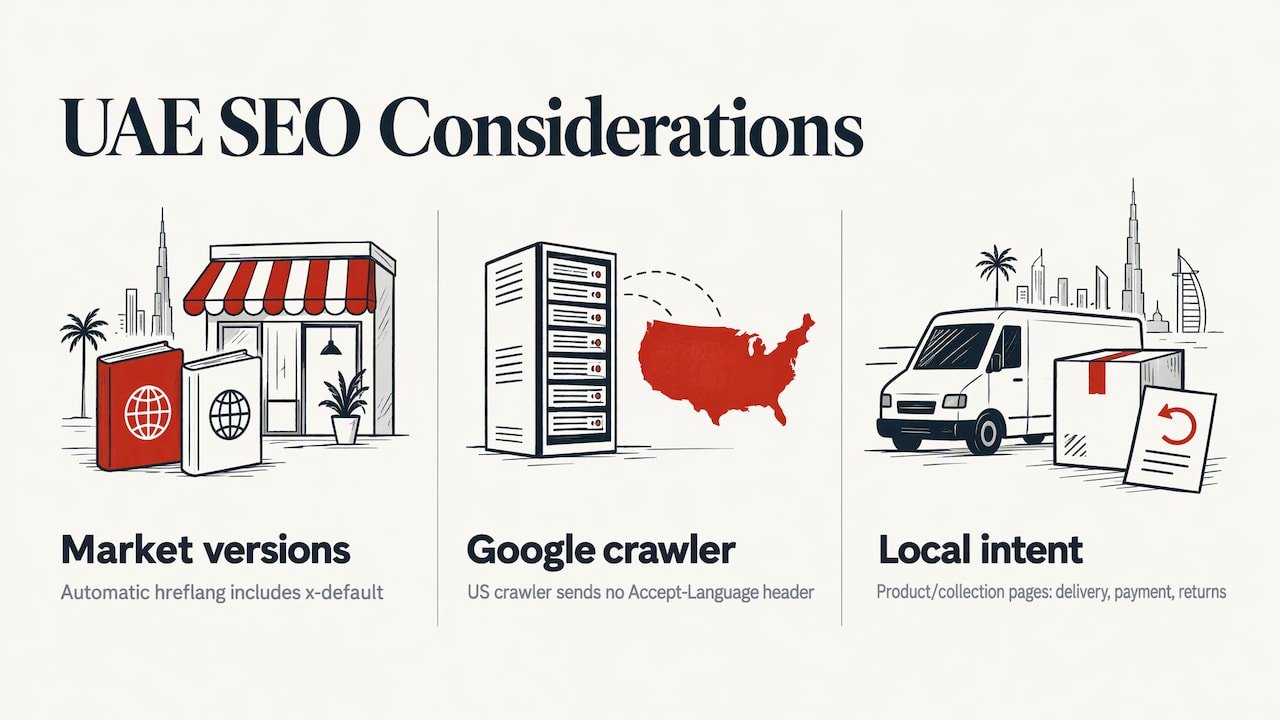
Search behaviour in Dubai and Abu Dhabi has its own patterns: shoppers search in English and Arabic, and many stores sell to several Gulf markets at once. We build campaigns around that behaviour rather than reusing a generic template. Technically, three points matter.
Language and market versions. Google’s documentation explains that hreflang tags tell Google about language and locale variations, each version must list itself and all other versions, and an x-default fallback should be provided. Shopify simplifies this: its Markets documentation says hreflang tags are generated automatically from your market and language configuration, including an x-default tag. On product pages, region-specific tags are generated only for markets that include the product. So if you sell in the UAE and Saudi Arabia, check that each product is assigned to the right markets.
What Google sees. Google’s crawler generally originates from the US and sends requests without an Accept-Language header. According to Google’s guidance, if your pages show different content depending on user location, you should be satisfied with what Google sees from its crawler’s location. Avoid automatic redirects based on location that could stop a crawler reaching your UAE pages.
Local intent. Dubai and Abu Dhabi buyers often compare delivery speed, payment options and returns before they compare price. Put those details on product and collection pages in plain language. Our UAE SEO page explains how we approach the region.
How to measure Shopify SEO results
Rankings alone do not pay the bills. A service should report on traffic and revenue too. These are the sources to set up:
- Google Search Console. Its Performance report gives total clicks, impressions, click-through rate and average position, with data for any date range over the past 16 months, plus location and device. The Pages section helps find indexing problems such as 404 errors, robots.txt blocks and redirect issues.
- GA4. Shopify says the Google & YouTube app automatically tracks page view, search, view item, add to cart, begin checkout, add payment information and purchase events, and that GA4 calculates stage conversion as the share of users moving from one event to the next.
- A reporting dashboard. Shopify suggests combining organic traffic, keyword rankings, backlinks and conversion rates over a set timeframe in a tool such as Looker Studio.
Common metrics to watch include search engine traffic, keyword rankings, engagement time, bounce rate, scroll depth, click-through rate and conversion rate. Ask any provider which of these they report each month, and whether revenue from organic search is one of them.
Turning visitors into revenue
SEO brings qualified visitors; conversion decides how many become customers. The two work best together. If a collection ranks but the page converts poorly, the fix is on the page: clearer product information, faster loading, simpler checkout. That is why we pair SEO with conversion rate optimisation for stores that want more revenue from the same traffic.
Agency or company: how to choose
The words agency and company are used interchangeably in search, and what matters is how the provider works. Compare on these criteria:
| Criterion | What to look for |
|---|---|
| Audit | Provided upfront, based on your real data from Search Console and analytics |
| Shopify knowledge | Clear understanding of canonicals, collections, themes, apps and Markets |
| Market focus | Experience with Dubai and Abu Dhabi search behaviour and bilingual queries |
| Reporting | Clicks, impressions, conversions and revenue, not rankings alone |
| Scope | Technical, content and link building, with development support when the theme needs changes |
| Contract | Clear deliverables, a defined review rhythm and transparent communication |
A few questions are worth asking in the first call:
- What will the audit cover, and when do we receive it?
- Who makes changes to the theme, and how are they tested?
- How do you report on organic revenue?
- How do you handle Arabic and English versions of the store?
- What does the engagement look like after the first three months?
If you want a view on budgeting before you speak to anyone, our SEO budget estimator is a starting point, and our guide on how much SEO costs in Dubai explains what drives the figures.
Our perspective on Shopify SEO
We start from the idea that a Shopify store is a revenue system, not a list of keywords. Search visibility, site speed, page design and checkout all feed the same number: orders from qualified visitors.
Our approach combines technical expertise, customer behaviour analysis and continuous optimisation. For Shopify stores in Dubai and Abu Dhabi, that means an audit grounded in real data and delivered upfront, then work on structure, content and conversion in a sensible order.
We build around local search behaviour, including bilingual queries, rather than rebranding a global template. We also report honestly, so you can see what changed, what did not and what we will do next.
Because we also build on Shopify, WordPress and WooCommerce, technical fixes do not wait in a queue for another vendor. The people who find the issue can fix it, and the people who fix it measure the effect.
the author
Work with Foureyes Solutions
We help e-commerce brands in the UAE and internationally attract qualified traffic and convert more of it. Our SEO team works on technical health, content and visibility in Google, and we extend that to AI search through GEO. If your store also needs theme or platform changes, our web development team handles Shopify, WooCommerce and WordPress builds.
To see what an engagement could look like for your store, start with our SEO services in Dubai and Abu Dhabi or get in touch through our website.
A sensible order of work
Stores often ask where to begin. This sequence keeps effort on what moves results first:
- Set up measurement. Add your domain to Search Console and confirm GA4 purchase tracking.
- Audit indexing and canonicals. Fix duplicate URL issues, conflicting tags and sitemap problems.
- Prioritise revenue pages. Optimise your top collections and best-selling products first.
- Check your markets. Confirm language and market assignments so hreflang tags are correct.
- Publish useful content. Add buying guides and answers to pre-purchase questions.
- Review monthly. Compare clicks, impressions, position and conversion rate, then decide the next round.
This order works because each step depends on the one before it. Content published before indexing is healthy is slower to pay back, and optimisation without measurement cannot be judged.
FAQ
What do Shopify SEO services cost in the UAE?
There is no single price, because scope, catalogue size and competition vary. Our own pricing is not published as a fixed figure, so we scope each store after an audit. Our guide to SEO costs in Dubai explains what drives the cost.
How long before a Shopify store ranks on Google?
Google says it indexes new or updated information on a Shopify store within 48 to 72 hours of it being added, but indexing is not the same as ranking well. Competitive terms usually need sustained work on content, structure and links, so ask any provider for a realistic plan rather than a fixed date.
Do I need an SEO app if I use Shopify?
Not necessarily. Shopify already generates canonical tags, a sitemap and robots.txt for you. If you do use an app, check that it does not add a second canonical tag or conflict with your theme, because Shopify’s checklist flags this as an issue to review.
Is a Shopify SEO agency different from a Shopify SEO company?
The labels overlap, and the deciding factors are the audit, the reporting and the team’s Shopify and UAE market knowledge. Use the criteria table above to compare any provider on equal terms.
Sources
- Shopify Help Center: SEO overview
- Google Search Central: SEO Starter Guide
- Google Search Central: Localized versions of your pages
- Shopify Help Center: International SEO for markets
- Shopify: Ecommerce SEO audit checklist
- Shopify: Duplicate content, how to find and fix issues
- Shopify: How to use Google Search Console
- Shopify: SEO tracking metrics, tools and tips
- Shopify: Google Analytics for ecommerce, GA4 setup
- Shopify: SEO reporting tools for ecommerce