Google Ads lets a clinic appear at the moment someone in Dubai or Abu Dhabi searches for a treatment, a doctor or an appointment. It works when four things line up: campaigns built around specific treatments and areas, ads and landing pages that meet healthcare policy and medical advertising rules, tracking that counts booked appointments rather than clicks, and a budget sized to the value of a patient. This guide covers each in the order you would set them up.
TL;DR
- Build campaigns around treatments and locations (for example, dental implants in Dubai Marina), not around one broad “clinic” theme.
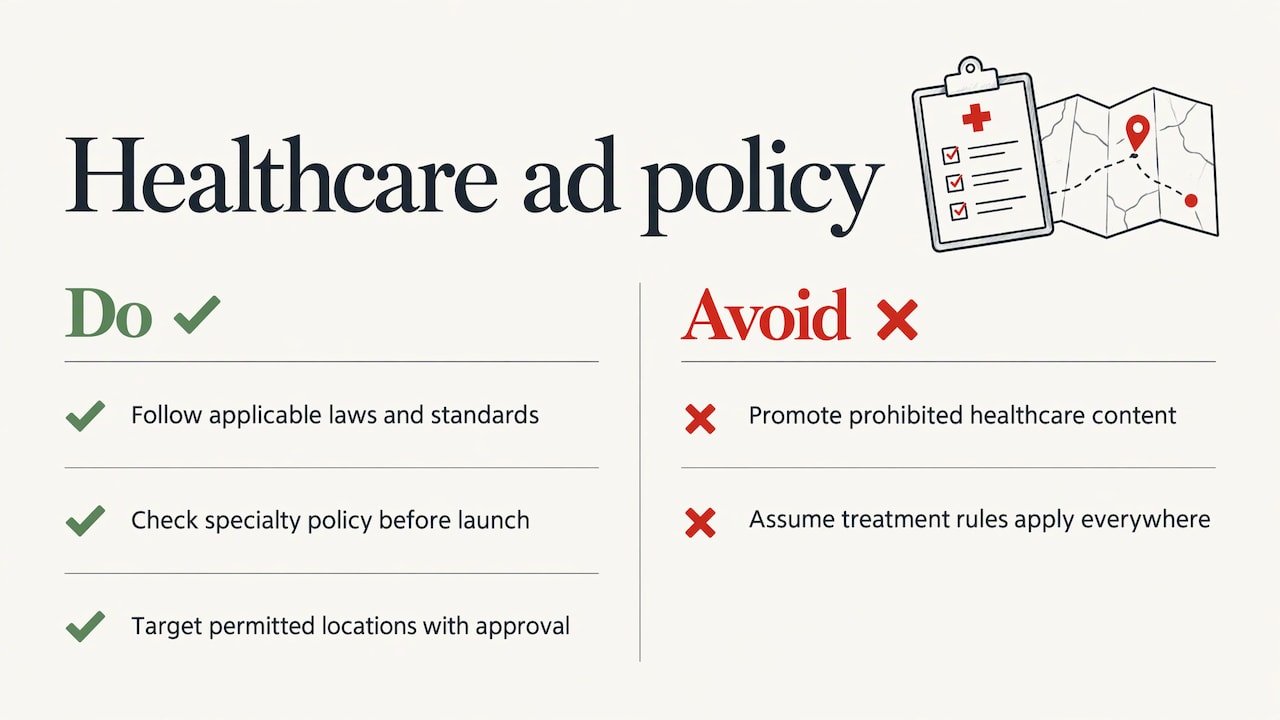
- Healthcare is a restricted category: Google expects ads and landing pages to follow applicable laws and industry standards, and UAE medical advertising rules apply on top.
- Health is a sensitive category for targeting, so advertiser-curated audiences such as Customer Match and lookalikes are not available for promoting it.
- Measure booked appointments and qualified calls, not clicks, and keep patient data out of your analytics.
- Fix the landing page and booking flow before raising the budget. Spend only multiplies what the page already does.
Table of Contents
- Why Google Ads suits clinics
- Know the rules before you write an ad
- How to structure campaigns around treatments and locations
- Targeting and remarketing restrictions
- Landing pages decide whether clicks become appointments
- Measuring what matters while protecting patients
- Budgeting for a UAE clinic
- Improving performance over time
- Where search, AI answers and paid ads meet
- Our perspective
- Work with a team that knows UAE healthcare search
- FAQ
- Sources
Why Google Ads suits clinics
Most patient decisions start with a search. Someone with a toothache, a skin concern or a child with a fever types what they need, often adding an area or the word “near me”. A search ad puts your clinic in front of that person while the need is active. That intent is the difference between Google Ads and social media advertising, where you interrupt people who were not looking.
For UAE clinics there are two further factors:
- Competition by area. Dense districts such as Jumeirah, Downtown, Business Bay and Al Reem Island have many clinics bidding on the same treatments. Specific campaigns beat generic ones.
- Bilingual search. Patients search in English and Arabic, and many mix the two. Your keyword lists, ad copy and landing pages should reflect both, not a translation of the English set.
We build every campaign around Dubai and Abu Dhabi search behaviour rather than adapting global templates, and the sections below follow that approach.
Know the rules before you write an ad
Healthcare advertising is regulated twice: by Google and by the UAE health authorities. Clinics that skip this step risk disapproved ads and, more seriously, regulatory problems.
Google’s healthcare policy
Google’s policy says healthcare ads and their destinations must follow appropriate laws and industry standards. Some healthcare content is prohibited, and other content can only be advertised in certain locations by advertisers who are approved. Read the policy page for your specialty before launch, particularly if you promote anything involving prescription medicines, supplements or devices. A treatment that is allowed in one country may not be allowed in another, so the location you target matters.
UAE medical advertising standards
The Dubai Health Authority publishes standards for medical advertisement content on social media for the facilities it licenses. They are written for social media, but they show how the regulator thinks about all patient-facing promotion. In summary, content must comply with federal and local law and be accurate, reliable, substantiated and culturally sensitive. The same document states that:
- Promotions that use a facility’s name or location need medical-director approval.
- Patient information must be protected, and documented consent is needed for any person or patient featured.
- Prohibited content includes guaranteed recovery, misleading effectiveness claims, patient-identifiable information, testimonials without written consent, and before-and-after images without the required disclaimer and risks.
Turn that into working rules for your Google Ads copy and landing pages:
- Never promise results. Write “consultation with a specialist” rather than “guaranteed results”.
- Have your medical director approve ad copy and landing page text before anything goes live.
- Keep patient stories, photos and reviews off your pages unless written consent is on file.
- If you use before-and-after images on a landing page, include the disclaimer and the risks the regulator requires.
Rules differ between Dubai, Abu Dhabi and the other emirates, and they are updated. Confirm the current requirements with your licensing authority (DHA in Dubai, the Department of Health in Abu Dhabi, or the Ministry of Health and Prevention for other emirates) before you publish.
How to structure campaigns around treatments and locations
The most common structure mistake is one campaign called “Clinic” with every service inside it. You cannot set budgets by profitability, you cannot see which treatment brings patients, and your ad copy ends up generic. Build around how patients search instead.
Campaign layer: one per service line
Split by the treatments that matter commercially. A multi-specialty clinic might run separate campaigns for dentistry, dermatology, physiotherapy and paediatrics. A dental practice might split cosmetic, implants, orthodontics and emergency care. Each campaign gets its own budget so a high-volume, low-value service cannot consume the money meant for a high-value one.
Ad group layer: one theme per ad group
Inside each campaign, group keywords that share one intent. For example:
- Treatment plus location: “dental implants Dubai Marina”
- Problem-led searches: “tooth pain at night”, “knee pain after running”
- Practitioner and facility searches: “female dermatologist Abu Dhabi”
- Urgent or same-day searches: “walk-in clinic near me”
Write ads that echo the search. A person searching “female dermatologist Abu Dhabi” should see that phrase in the headline and land on a page about exactly that.
Keywords and match types
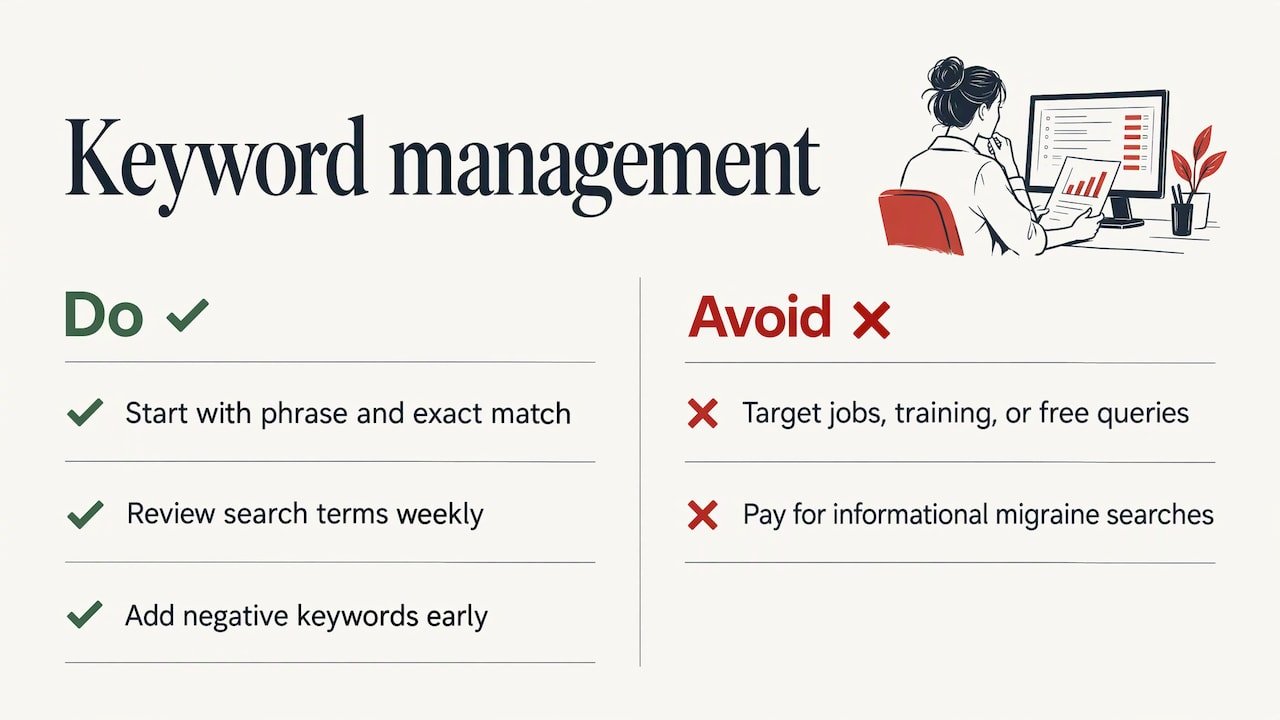
Start with phrase and exact match on treatment and location terms, and review the search terms report weekly. Add negative keywords early. Typical exclusions for clinics are job searches (“jobs”, “vacancy”, “salary”), training queries, free-service queries and conditions you do not treat. Informational searches such as “what causes migraines” rarely convert to bookings and are best handled with content on your site rather than paid clicks.
Location targeting
Target the emirate or the catchment area patients will really travel from, usually a radius around the clinic or a set of neighbourhoods. Use presence-based targeting so you reach people in or regularly in the area, and check that your ads are not showing in places you cannot serve. Location targeting and Google’s predefined audiences are the options that remain open to health advertisers, so getting geography right is your main lever.
Ad copy that passes review and persuades
Good clinic ads are specific and calm. Include the treatment, the area, a clear next step and a credible proof point you can substantiate, such as the practitioner’s licensed specialty or opening hours. Avoid superlatives you cannot back up (“best clinic in Dubai”) and any outcome claims. Use assets such as call, location and sitelink extensions so the ad takes up more space and gives patients several routes to contact you.
Targeting and remarketing restrictions
This is where healthcare differs most from retail or services. Google classes health as a sensitive category. For health promotion, advertiser-curated audiences, including Customer Match, advertiser data segments, audience expansion and lookalikes, cannot be used. The same page notes that users under 18 are not eligible for personalised advertising.
In practice:
- Do not plan a strategy that depends on uploading patient lists or retargeting people who visited a treatment page. Check the current policy before building any audience.
- Put more weight on search intent, keyword structure, location and ad quality, which are all available to you.
- Use the predefined Google audiences where they are eligible for your account.
- Do not use patient information to target. It would also clash with the confidentiality duties in the UAE standards described above.
Landing pages decide whether clicks become appointments
A click costs the same whether the visitor books or leaves. The landing page is therefore where most clinic campaigns win or lose money. Send each ad group to a page about that treatment, not to the homepage.
A strong clinic landing page usually has:
- A headline matching the search (treatment and area).
- The clinic’s licensing and the practitioner’s specialty, stated factually.
- A booking form or booking button above the fold, plus a tap-to-call number on mobile.
- Clear opening hours, address and map, and the languages your team speaks.
- A short explanation of what the first visit involves.
- Only claims and imagery your medical director has approved.
Most UAE healthcare searches happen on a phone, so check load speed and the mobile form. A slow page or a long form loses patients you already paid for. This is the territory of conversion rate optimisation: a heuristic audit of the page, then A/B tests that show which changes improve the enquiry rate. If your site itself needs rebuilding, our web development team works on WordPress, Shopify and WooCommerce.
Measuring what matters while protecting patients
Clicks and impressions tell you little. A clinic needs to know how many appointments were booked and from which campaign.
What to track
- Calls from ads and from the website, with a minimum call length so short misdials do not count.
- Form submissions and online bookings, tracked as conversions.
- WhatsApp taps, which are an important contact route in the UAE.
- Booked and attended appointments, which you reconcile against your front desk records, not just the platform’s numbers.
Keeping patient data out
Track the action, never the person. Do not pass names, medical conditions, appointment details or other identifiable information into analytics or ad platforms through form fields, page URLs or event parameters. This matches both Google’s treatment of health as sensitive and the confidentiality duties in the DHA standards. Ask your developer to review what the tracking code collects, and have your compliance lead sign off the setup.
Closing the loop
The number that matters is cost per booked patient, then the value of that patient over time. A cosmetic dentistry enquiry and a general consultation have very different values, so judge each campaign against its own margin. Tell your reception team to ask every caller how they found you and log it. It is imperfect, but it catches the calls that tracking misses.
Budgeting for a UAE clinic
There is no honest single figure, because cost per click varies by specialty, area and season, and high-value treatments are generally more competitive. Work backwards instead:
- Decide what a new patient is worth to you for the treatment in question.
- Estimate how many enquiries become booked patients (your front desk knows this).
- Estimate what share of clicks turn into enquiries on your landing page.
- Set a target cost per booked patient that leaves a margin, then divide it back to a maximum cost per click.
If the maths only works at a very low cost per click, the treatment may be too competitive to start with. Begin with narrower, more specific services and expand. We cover the cost components in more detail in our guide to how much Google Ads cost in Dubai, and our Google Ads budget Dubai archive has related articles. Remember that your budget has two parts: media spend paid to Google, and management or agency fees.
Improving performance over time
Review on a fixed rhythm:
- Weekly: search terms report, new negative keywords, budget pacing, call and form quality.
- Monthly: cost per booked patient by campaign, ad copy tests, landing page changes, device and location splits.
- Quarterly: which treatments to push or pause, seasonal patterns such as pre-summer cosmetic demand or back-to-school health checks, and whether to add Abu Dhabi or other emirates.
Allow enough data before judging a test. Declaring a winner on a handful of conversions is how clinics end up chasing noise, so wait for statistical significance before rolling out a change.
Mistakes we see most often
- Sending all traffic to the homepage. Patients cannot find the treatment they searched for.
- Broad match without negatives. Budget drains into irrelevant searches.
- Counting clicks, not bookings. The dashboard looks healthy while the diary stays empty.
- Ignoring after-hours and call handling. Paid calls that go to voicemail are wasted spend.
- Publishing unapproved claims. Outcome promises and unconsented testimonials risk disapproval and regulatory trouble.
- Relying on remarketing lists. Restricted for health, so build the plan on search intent.
- Switching off campaigns too early. Healthcare decisions can take days, so allow a full learning period and review by treatment.
Where search, AI answers and paid ads meet
Paid search covers demand today. Patients also research through organic results and AI assistants, so a clinic that appears in all three earns trust faster. Our SEO and generative engine optimisation work builds the content foundation that supports your paid campaigns, and better treatment pages improve ad landing page quality as well.
Our perspective
Most clinics we speak to have the same story: some spend on Google Ads, a report full of clicks, and no clear answer to how many patients walked in. We think the fault is rarely the platform. It is usually structure, tracking and the landing page.
Our approach starts with real data and an audit provided upfront. We look at how patients in Dubai and Abu Dhabi actually search, in English and in Arabic, and we build campaigns around treatments and districts rather than rebranding a global template.
We report honestly. If a campaign is not producing booked appointments, we say so and show where the problem sits: the keywords, the page, the booking flow or the budget. For clinics, that also means working inside healthcare policy and the regulator’s expectations, with your medical director approving what goes live.
Paid search, conversion optimisation and technical SEO work best together. Ads bring qualified people to the door, and the website decides whether they come in.
the author
Work with a team that knows UAE healthcare search
If you want campaigns built around your specialties, areas and booking process, our Google and Meta Ads service covers account setup, management, tracking and reporting for businesses in Dubai and Abu Dhabi. We begin with an audit grounded in your own data, so you see where the opportunity is before you commit.
You can also read more in our paid ads and UAE market articles, or get in touch through foureyessolutions.com.
FAQ
Can a clinic in the UAE advertise on Google Ads?
Yes, provided the ads and landing pages comply with Google’s healthcare policy and UAE law. Google states that some healthcare content is prohibited and some can be promoted only by approved advertisers in certain locations. Confirm requirements with your licensing authority and have your medical director approve the copy.
Can I retarget patients who visited my website?
Not with advertiser-curated audiences. Google’s policy for health in personalised advertising does not allow Customer Match, advertiser data segments, audience expansion or lookalikes for sensitive health promotion. Focus on search intent, location targeting and eligible predefined audiences instead, and check the current policy page before you plan.
What should I track to know if Google Ads is working?
Track booked appointments, qualified calls, form submissions and WhatsApp taps, then compare them with your front desk records. Report cost per booked patient rather than cost per click. Keep names, conditions and appointment details out of your analytics and ad platform data.
Can I use patient reviews or before-and-after photos in my ads?
Only with care. The DHA standards prohibit testimonials without written consent and before-and-after images without the required disclaimer and risks, and they require documented consent for anyone featured. Have your medical director and compliance lead approve every item before it appears on an ad or landing page.
Sources
- Healthcare and medicines – Advertising Policies Help
- Health in personalized advertising – Advertising Policies Help
- Advertisement content on social media, Dubai Health Authority standards