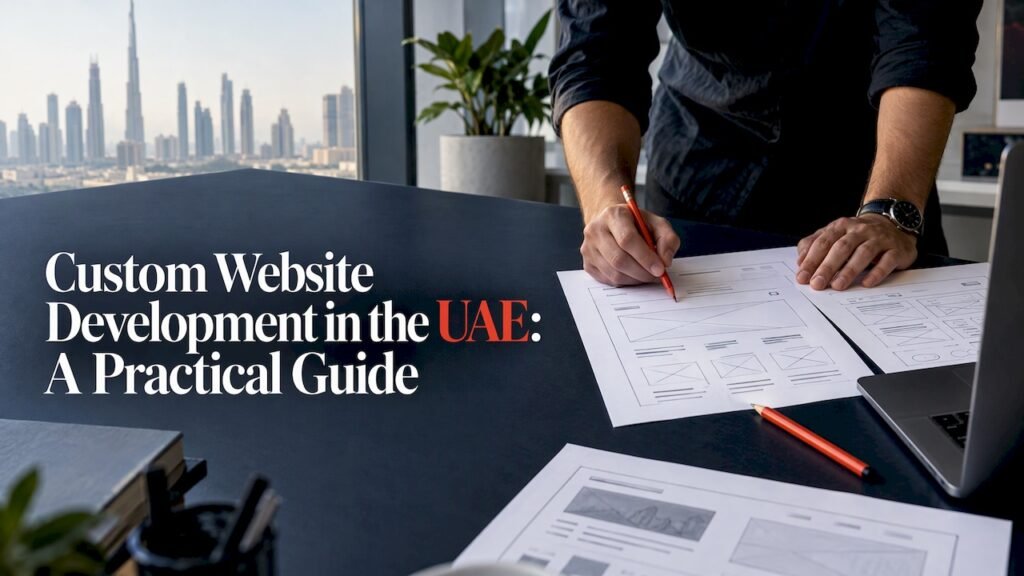
Custom website development means a site is designed and built around your business: your customers, your sales process and your systems, rather than a pre-made template. For a UAE business it makes sense when a template can no longer support your bilingual content, integrations, lead funnels or growth plans. This guide explains what you get, what it involves, how to judge an agency and how white-label development works for agencies.
TL;DR
- Custom development builds the structure, design and functionality from your requirements. Templates adapt your requirements to a ready-made layout.
- It pays off when you need integrations, complex journeys, Arabic and English versions, or tight control over speed and SEO.
- Cost and timeline depend on scope: number of templates, integrations, content volume and approvals. Define scope before you ask for quotes.
- Judge an agency on discovery, data-led audits, ownership terms and post-launch support, not only on design samples.
- White-label development lets agencies resell build capacity under their own brand while a specialist team does the work.
Table of Contents
- What custom website development means
- Custom or template: how they differ
- When a UAE business needs a custom website
- What custom website development services include
- What affects cost and timeline
- How to choose a custom web development agency
- Our perspective on custom builds
- SEO, performance, security, ownership and support checks
- White-label web development for agencies
- B2B websites: what to prioritise
- Plan your custom website with us
- FAQ
- Sources
What custom website development means
A custom website is planned and coded for one organisation. The agency starts from your goals, maps the pages and user journeys, designs each template, and then builds the front end (what visitors see) and the back end (how content, forms, data and integrations are managed).
The platform can still be familiar. At Foureyes Solutions we build on WordPress, Shopify and WooCommerce, and also take on custom or headless platforms where the project needs it. “Custom” describes the approach, not a refusal to use proven tools. A bespoke WordPress theme with purpose-built page types and a clean content model is custom. A purchased theme with your logo dropped in is not.
Typical custom projects include:
- Brochure and corporate sites with a bespoke design and structure built for lead generation.
- E-commerce stores with custom product pages, checkout adjustments, bundles or B2B pricing.
- Service-sector sites for law firms, clinics and real estate companies, with enquiry and booking flows.
- Headless or custom platforms where content is managed in one system and delivered to a separate front end.
Custom or template: how they differ
Neither is wrong by default. The question is whether your requirements fit inside a template’s limits.
| Factor | Template-based site | Custom-built site |
|---|---|---|
| Design | Chosen from existing layouts, lightly adjusted | Designed from your brand, audience and conversion goals |
| Structure | Fixed page types and blocks | Page types and content model built for your needs |
| Functionality | Plugins and add-ons | Built-in features and tailored integrations |
| Performance | Includes code for features you may not use | Only the code the site needs |
| Bilingual and RTL | Depends on the template’s support | Planned from the start for English and Arabic |
| Upfront effort | Lower | Higher, because discovery and design come first |
| Scalability | Constrained by the template | Designed around where the business is going |
The real comparison is often total cost over time. A template can look cheaper at launch, then collect plugin workarounds as the business grows. A custom build costs more to plan, but the structure is made to be extended.
When a UAE business needs a custom website
Signs that you have outgrown a template:
- Your journeys are not standard. A law firm routing enquiries by practice area, a clinic with booking by specialist, or a developer with filtered property listings all need logic a generic layout does not provide.
- You operate in Arabic and English. Right-to-left layouts, translated URLs and language-specific search behaviour are easier to get right when planned from the first wireframe. Search habits in Dubai and Abu Dhabi also differ from global patterns, which is why we build around local behaviour rather than reusing global templates.
- You must connect other systems. CRMs, booking engines, payment gateways, ERP or inventory tools often require custom integration work.
- Conversion is the goal. If the site exists to produce enquiries or sales, layout, copy and forms should be designed around measured visitor behaviour. That links custom development directly to conversion rate optimisation.
- Speed and technical SEO matter. Custom builds give you control over page structure, URLs and loading behaviour.
- You are preparing for AI search. Clean structure and well-organised content help your pages be understood by search engines and AI answer tools, which is the focus of generative engine optimisation.
If none of these apply, a well-configured template site may be enough for now. A good agency will tell you which category you are in after a short discovery conversation.
What custom website development services include
Scopes vary, but a complete engagement normally covers these stages.
1. Discovery and requirements
The agency clarifies business goals, target audiences, competitors, existing analytics and technical constraints. The output is a written requirements document: pages, features, integrations, languages and success measures. Our audits are grounded in real data and provided upfront, so decisions rest on how your visitors behave today, not on assumptions.
2. Information architecture and wireframes
This is the site map and the skeleton of each page template. It decides where visitors enter, what they see first and how they reach a form, a booking or a checkout. Mistakes here are the most expensive to fix later.
3. Design
Visual design applies your brand to the approved wireframes, usually for desktop and mobile, with Arabic layouts where needed. Expect a review round on key templates, then a design system for buttons, forms and typography.
4. Development
Developers build the theme or front end, set up the content management system, and code custom features. Work is normally done on a staging site you can review.
5. Integrations and content
Forms connect to your CRM, analytics and tracking are installed, payment or booking tools are configured, and content is migrated or loaded. Content is the most common cause of delays, so agree who provides it and when.
6. Testing and launch
Testing covers devices and browsers, forms, speed, accessibility basics, security settings and redirects from old URLs. Redirect mapping protects the search rankings you already have.
7. Support and optimisation
After launch, sites need updates, backups, monitoring and improvement. The strongest results come from continuing to test and refine pages using real visitor data.
What affects cost and timeline
Price and duration follow scope, not the word “custom”. The main drivers:
- Number of unique page templates (a five-template site is a different job from a thirty-template one).
- Integrations with CRMs, booking, payments, ERP or inventory.
- Languages, including Arabic right-to-left design.
- E-commerce complexity: product types, shipping rules, B2B pricing.
- Content volume and whether copy, photography and video are produced or supplied.
- Approval speed on your side. Slow feedback extends any timeline.
We do not publish fixed prices because they depend on these variables. To see a realistic range for your project, use our website cost calculator and read our Dubai website development cost guide. Comparing quotes only works when every agency prices the same written scope.
How to choose a custom web development agency
Use a short checklist rather than a gut feeling.
- Relevant experience. Ask for work in your sector and market. Law, e-commerce, real estate and professional services each have different conversion patterns.
- A real discovery stage. An agency that quotes before asking about your goals is pricing a template.
- Data before design. Ask how analytics, heatmaps and user behaviour inform the design.
- Clear deliverables. The proposal should list pages, features, integrations, revision rounds and what counts as out of scope.
- SEO built in. URL structure, metadata, schema, redirects and speed should be part of the build, not an add-on afterwards.
- Transparent reporting. You should know what is being done, why and with what result.
- Ownership terms. Confirm in writing that you own the design, the code written for you and the hosting and domain accounts, subject to any third-party licences.
- Support after launch. Check what maintenance, security updates and optimisation are available.
Write your own requirements first. A one-page brief covering goals, audiences, must-have features, integrations, languages, deadlines and a budget range produces quotes you can compare.
Our perspective on custom builds
Most of the websites we are asked to rebuild did not fail on looks. They failed because nobody connected the design to how visitors search, compare and decide. In the UAE that gap is wider, because buyers search in two languages and often move between mobile, WhatsApp and the website before they enquire.
That is why we treat development, SEO and conversion work as one job. We build every campaign and site around Dubai and Abu Dhabi search behaviour rather than rebranding global templates, and we begin with an audit based on your own data. The structure we build is meant to be measured and improved after launch, not handed over and forgotten.
A custom site is an investment, so we believe you should see where the money goes: what is being built, why, and what it should change in your enquiries or revenue. Honest reporting is part of the service.
the author
SEO, performance, security, ownership and support checks
Before you sign off a build, check these five areas.
Technical SEO. Confirm clean URLs, unique titles and descriptions, structured data, XML sitemap, correct language tags for English and Arabic versions, and a complete redirect map from the old site. If you want a team to manage rankings after launch, see our SEO services in Dubai and Abu Dhabi.
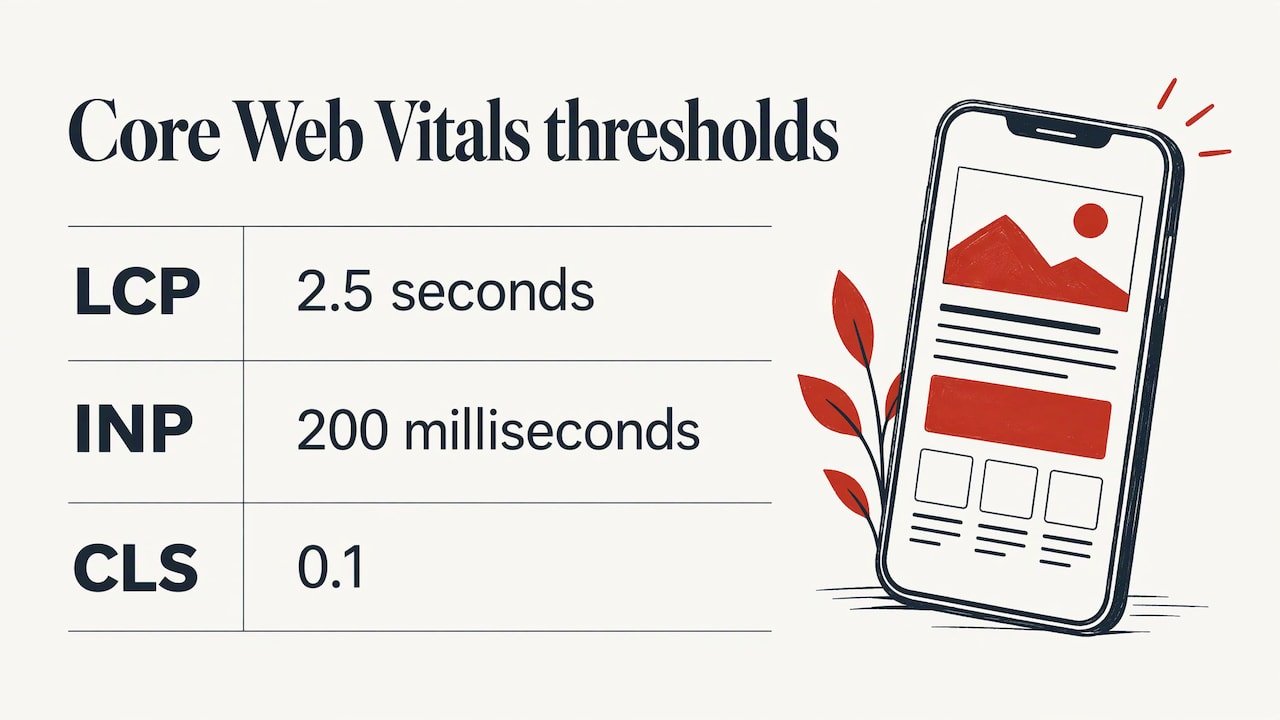
Performance. Google’s Core Web Vitals measure real-user loading, responsiveness and visual stability. Google’s guidance lists good thresholds of 2.5 seconds for Largest Contentful Paint, 200 milliseconds for Interaction to Next Paint and 0.1 for Cumulative Layout Shift. Ask the agency to test against these on mobile before launch.
Security. Ask about hosting, SSL, access controls, backups, update routines and how forms that collect personal data are protected. Clinics and law firms in particular collect sensitive enquiries, so ask what is stored, where and for how long.
Ownership. Get in writing who owns the code, design files, content and accounts, and what happens if you change agency. Licensed third-party plugins or themes usually remain under their own licences.
Ongoing support. Agree the scope of maintenance: updates, monitoring, small changes, and continuing conversion testing. A site that is never touched after launch slowly loses ground.
White-label web development for agencies
White-label web development means a specialist team builds websites that another agency sells under its own brand. The client relationship stays with the reselling agency. The development partner works behind the scenes on design implementation, theme and plugin builds, Shopify or WooCommerce setups, technical SEO and fixes.
It suits agencies that sell websites but do not want to hire a full development team, or that need extra capacity during busy periods. B2B companies commissioning a site benefit indirectly: the agency they hire can deliver more reliably.
If you are an agency looking for a development partner, agree these points first:
- Scope and handover: what you supply (designs, copy, briefs) and what the partner delivers (staging site, documentation, final files).
- Confidentiality: the partner should not contact or market to your clients.
- Quality standards: coding practices, testing, browser coverage and speed targets.
- Revisions and support: how many rounds are included and who fixes post-launch issues.
- Ownership: code and assets should transfer to you and your client as agreed.
We support digital agencies in the UAE and internationally with white-label website development, CRO and technical SEO, and we also offer non-exclusive code licensing for agencies and founders who want to start from proven components.
B2B websites: what to prioritise
B2B buyers research for longer and involve several people, so the site must serve different roles. Put the emphasis on:
- Clear service pages that state who each service is for and what happens next.
- Proof: case studies, sector experience and credentials you can support.
- Low-friction enquiry paths: short forms, direct contact options and consultation booking.
- Resources that answer buying questions, which also feed organic search.
- Measurement: tracking that shows which pages produce qualified leads, not just traffic.
Plan your custom website with us
Foureyes Solutions builds websites on WordPress, Shopify and WooCommerce, as well as custom and headless platforms, for businesses in Dubai, Abu Dhabi and beyond. We combine web development with SEO, CRO and paid advertising so the site is built to be found and to convert.
Start with the website cost calculator to shape your scope, or contact us through our website for a data-led audit and a conversation about what your site needs.
FAQ
Is custom website development better than using a template?
It is better when your requirements go beyond what a template supports: special journeys, integrations, bilingual structure or conversion-led design. If your needs are simple, a well-configured template can be enough. A discovery conversation will show which applies to you.
How long does a custom website take to build?
It depends on the number of templates, integrations and the volume of content, and on how quickly you approve each stage. A smaller brochure site is quicker than a multi-language store with integrations. Agree a milestone plan in writing before work starts.
What is the difference between white-label web development and a normal agency?
With white-label development, an agency resells the work under its own brand, and the specialist team stays behind the scenes. With a normal agency, you deal with the builder directly. The technical work can be identical.
Will I own my custom website?
You should, and the contract should say so. Confirm ownership of the design, the code written for you, the content and the hosting and domain accounts. Third-party themes and plugins stay under their own licences.
Do I need SEO as part of the build?
Yes, the technical foundations should be built in: URL structure, metadata, speed, structured data and redirects. Ongoing content and link work can then follow once the site is live.