
Ecommerce website development is the work of building the online store where you sell: design, product catalogue, cart, checkout, payments, security and the integrations behind them. For a UAE business, a store that is built well is one that loads fast on a phone, accepts the payment methods local shoppers use, can be found in Google and AI search, and is structured so that conversion rate can be improved after launch. We build stores on Shopify, WordPress and WooCommerce, and this guide sets out what to specify, in what order, and where projects usually go wrong.
TL;DR
- Development covers the front end (what shoppers see), the back end (orders, stock, data) and the integrations (payments, shipping, analytics), as Shopify’s guide and BigCommerce’s guide both describe it.
- Build in five stages: strategy, design and UX, development and integration, testing, then launch and ongoing maintenance.
- In the UAE, plan for mobile first, local payment options such as Apple Pay, buy now pay later and cash on delivery, and Arabic and English content.
- Search structure, speed and tracking belong in the build brief, not in a later project.
- Judge an agency by revenue, conversion and orders, not by impressions and clicks.
Table of Contents
- What ecommerce website development includes
- The stages of an ecommerce build
- Choosing between Shopify, WooCommerce and a custom build
- What a UAE store has to plan for
- Build for search and AI answers from the start
- Build conversion into the store, not on top of it
- How to brief and judge a development agency
- Our view: the build is the start of the revenue work
- Plan your store with Foureyes Solutions
- FAQ
- Sources
What ecommerce website development includes
A store is more than a design. Shopify describes the work as building the platform you sell on, including website design, product catalogue, shopping cart, secure payment gateway integration, security, SEO, mobile responsiveness and customer service. BigCommerce splits it into three layers, which is a useful way to brief any project:
| Layer | What it covers | What goes wrong if it is skipped |
|---|---|---|
| Front end | Layout, navigation, product and collection pages, search, filters | Shoppers cannot find or compare products, so they leave |
| Back end | Order management, stock, customer data, content management | Overselling, manual rework, slow reporting |
| Integrations | Payment gateways, shipping providers, analytics, CRM, marketing tools | Failed payments, missing data, no way to measure results |
On the shopper-facing side, Shopify’s feature guide lists nine essentials: homepage, mobile site, navigation, search bar, product pages, collection pages, an about page, filtering and a wish list. It says a product page needs at minimum photos, a clear description, a price and a Buy button. Extras such as size charts can sit in collapsible sections so the page stays short.
A useful test for your own brief: every item should either help a shopper decide, help them pay, or help you measure what happened. If a feature does none of the three, it can wait.
The stages of an ecommerce build
Razorpay’s guide outlines five stages. They match how a well-run project goes, so we use them here with the UAE detail added.
- Planning and strategy. Define who buys, what they buy, the average order value you want, and which markets you serve (UAE only, GCC, or international). This is also where fulfilment is decided: in-house, dropshipping or a third-party logistics provider, plus shipping and returns policies. Decisions made here change the platform and integration list.
- Design and UX. Wireframe the paths a shopper takes: landing page to product page to cart to checkout. Design for the phone first, then scale up.
- Development and integration. Build the theme or custom front end, connect payments, shipping rates, tax settings and analytics, and migrate products if you are leaving an old store.
- Testing and optimisation. Place real test orders on every payment method and device. BigCommerce’s pre-launch checklist includes checkout testing, optimised images, tax settings, inventory and promo codes.
- Launch and maintenance. Razorpay lists security updates, backups and conversion optimisation as continuing tasks. A store is never finished on launch day.
The Shopify UAE launch checklist breaks the same journey into 20 steps, from choosing a platform and domain to business licences, tax and shipping settings, checkout testing, apps and analytics. Use it as a cross-check against your own plan.
Choosing between Shopify, WooCommerce and a custom build
An ecommerce platform is where you build and manage your store. Shopify’s UAE guide names Shopify, Wix, WooCommerce and BigCommerce as popular options and notes that store builders let you customise by drag and drop without coding. That convenience is real, but the platform decision still shapes your costs, flexibility and growth path. A practical way to choose:
| If you… | Platform that usually fits |
|---|---|
| Want a managed, quick-to-launch store with a strong app ecosystem | Shopify |
| Already run a WordPress site, publish a lot of content, or need deep control over templates and data | WooCommerce on WordPress |
| Have complex catalogues, multiple storefronts, unusual pricing logic or ERP-heavy operations | Custom or headless platform |
| Sell a few lines to a local audience and need a credible, fast brand presence | A brochure site with a simple checkout |
We develop for Shopify, WordPress and WooCommerce, and we also build custom and headless platforms and brochure sites. If you are leaning towards WordPress, our page on WooCommerce development for UAE online stores covers that route in more detail. If you want a rough sense of how scope affects budget before you speak to anyone, the website cost calculator lets you compare a brochure site with a custom platform.
What a UAE store has to plan for
The same store template does not work everywhere. Three UAE realities should be in the brief from day one.
Payments
UAE shoppers expect a mix of methods. TrueHost’s UAE payment guide lists Visa and Mastercard, Apple Pay and Google Pay, bank transfers and QR payments, buy now pay later providers such as Tabby and Tamara, and cash on delivery. It also explains that gateway providers need a Central Bank of the UAE licence and that merchants should work within card-industry security standards (PCI DSS) and 3D Secure authentication. In practice, choosing a licensed gateway that handles card data on its own hosted fields keeps your store out of the most demanding parts of that compliance. Ask your developer to document exactly how card data flows.
On mobile, wallet payments matter. A UAE payment gateway comparison reports that about 70% of UAE ecommerce traffic is mobile, and that mobile conversion trails desktop. Fewer fields at checkout and one-tap wallets are the usual response.
Delivery and cash on delivery
Cash on delivery still features in the UAE, particularly outside the main cities. That affects the build: you need an order status flow for cash collection, clear delivery timeframes shown before checkout, and real-time shipping rates where your courier supports them. Zoho’s guide recommends real-time shipping rates, automated tax calculation and transparent delivery information alongside reliable gateways.

Language and localisation
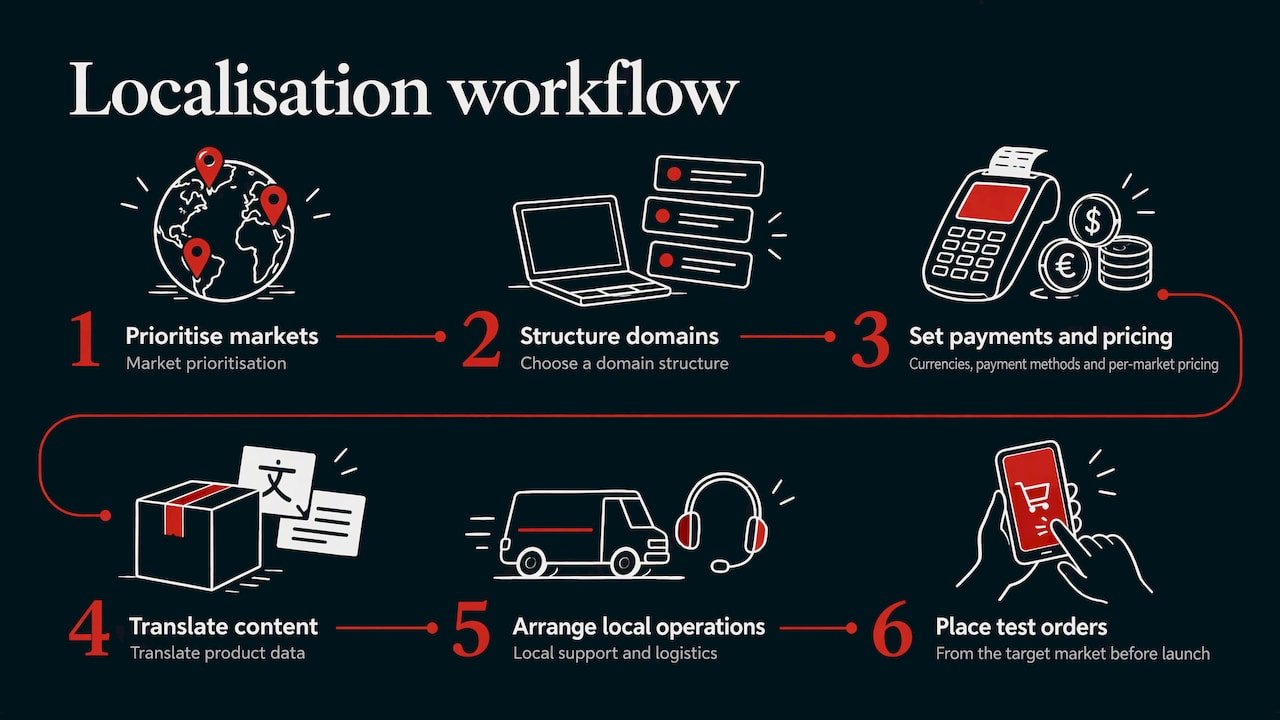
If you sell to both Arabic and English speakers, plan for right-to-left layouts, translated product data and local currency display from the start. Retrofitting them is slower and costlier than designing for them. Shopify’s localisation guide suggests an eight-step framework covering market prioritisation, domain structure, currencies and payment methods, per-market pricing, content translation, local support, logistics and testing. It also recommends test orders from the target market before launch and tracking conversion rate, cart abandonment and average order value by market afterwards.
Build for search and AI answers from the start
A store that nobody finds does not earn revenue, however well it is built. The Shopify UAE checklist notes that Google still accounts for almost 80% of search and treats keyword research, schema markup, sitemaps and site speed as core ecommerce SEO tactics. Those items are cheapest to get right during development:
- URL and collection structure that mirrors how people search, so categories can rank for the terms buyers use.
- Structured data (schema markup) on products, so search engines and AI assistants can read price, availability and reviews.
- Speed: compressed images, lean themes and a careful app list. Every plug-in you add can slow the page.
- Clean technical foundations: sitemaps, canonical tags and no duplicate pages created by filters. Our guide to technical SEO services explains what this covers, and our Shopify SEO article applies it to that platform.
- Bilingual content that is written for Dubai and Abu Dhabi search behaviour, not translated word for word from a global template.
Search is also changing. Shoppers now ask AI assistants for product recommendations as well as typing queries into Google. Generative Engine Optimisation (GEO) is the practice of making your brand and products easy for those assistants to find and cite, and clear product data and content are its base. We cover it as a separate service, alongside SEO in Dubai and Abu Dhabi.
Build conversion into the store, not on top of it
Traffic only pays when visitors buy. Conversion rate optimisation (CRO) is the structured process of finding why visitors do not buy and testing fixes. It works best when the store is built so that changes are easy to make and measure.
Practical points for the build brief:
- Analytics set up before launch. Track traffic sources, product sales, user behaviour and customer feedback. Shopify’s UAE guide says to review them regularly and use the insights to improve conversion rate.
- Product pages that answer the buying question. Clear photos, price, delivery information and reviews. Salesforce reports that 93% of consumers say online reviews affect their purchasing decisions, so build a place for them.
- A short checkout. Guest checkout, wallets and visible delivery costs reduce abandonment.
- Testable templates. Reusable sections let you run A/B tests (comparing two versions of a page) without a developer rebuilding the page each time. A test needs enough orders to reach statistical significance, meaning the difference is unlikely to be chance, so low-traffic stores start with a heuristic audit: an expert review of the pages against known usability principles.
For how this work is structured over time, see our article on what to expect from a CRO agency in the UAE.
If your store has a physical side, such as shops, warehouses or delivery teams, the operational layer needs tools as much as the website does. Store operations software covers tasks, stock counts and team scheduling, which complements the website’s own order and inventory data.
How to brief and judge a development agency
An ecommerce agency is a business that helps brands sell more online by building and maintaining the store, running marketing, or both. Shopify’s UAE agency guide separates development agencies, which handle architecture, themes, custom app integrations and migrations, from growth agencies, which handle paid media, SEO, email, SMS and CRO. The best results come when both disciplines are planned together, because a build without acquisition plans gets no traffic and acquisition sent to a poorly built store wastes budget.
Questions worth putting to any agency:
- Which platform do you recommend for our catalogue, and why? The answer should come from your products and operations, not from the agency’s habit.
- How will payments, delivery and Arabic content be handled? You want specifics for the UAE.
- What is built in for SEO and tracking? Schema, speed, analytics and URL structure should be named.
- What will the reports show? Shopify’s guide says reports should show revenue attribution, return on ad spend (ROAS) and conversion trends rather than vanity measures like impressions and clicks.
- What happens after launch? Maintenance, security updates, backups and optimisation need an owner.
Our own approach is to start from real data: audits are grounded in your analytics and provided upfront, and reporting is meant to be transparent about what is and is not working.
Our view: the build is the start of the revenue work
We build every campaign around Dubai and Abu Dhabi search behaviour rather than rebranding global templates, and the same principle applies to a store build.
Most online stores are scoped as a design project and judged as a revenue project. We think the brief should be written the other way round: begin with the orders, average order value and enquiries you need, then decide the platform, structure and integrations that get you there.
That is why we put web development, SEO, GEO, CRO and paid advertising under one roof. A store that is technically sound, discoverable in Google and AI search, and set up for testing gives each pound or dirham of marketing spend more to work with. Bilingual search behaviour, sector knowledge in e-commerce, law and professional services, and honest reporting are how we try to make that real for our clients.
The best moment to involve conversion and search specialists is before the first page is designed, when changes cost the least.
the author
Plan your store with Foureyes Solutions
If you are planning a new store, a rebuild or a migration, our web development team builds on WordPress, Shopify and WooCommerce, with brochure and custom or headless options for more complex needs. The same team can connect the build to conversion rate optimisation, SEO, GEO and Google and Meta advertising, so the store is ready to be found and improved from launch.
We publish no fixed prices because scope varies widely. The website cost calculator is the quickest way to frame a brochure or custom project, and you can start a conversation through foureyessolutions.com.
FAQ
What is ecommerce website development?
It is the design, build and maintenance of an online store, covering the product catalogue, cart, checkout, payment integration, security, search optimisation and mobile experience. It spans the front end shoppers see, the back end that manages orders and stock, and the integrations that connect payments, shipping and analytics.
Which platform is best for a UAE online store?
Shopify suits businesses that want a managed platform and a fast launch. WooCommerce suits those who want more control or already use WordPress. A custom or headless build suits complex catalogues or operations. The right choice follows your product range, markets and growth plans, so decide it at the planning stage.
What does an ecommerce web development agency do?
A development agency handles store architecture, theme development, custom integrations and platform migrations. Many also add SEO, CRO and paid advertising so that the store attracts and converts traffic after launch. We offer web development together with those growth services.
Which payment methods should a UAE store offer?
Cards, Apple Pay and Google Pay are the baseline, and buy now pay later and cash on delivery are common in the UAE. Use a gateway licensed in the UAE and check its card-security requirements with your developer before launch.
How long does a store need to be maintained after launch?
For as long as it trades. Security updates, backups, speed checks and conversion improvements are continuing tasks, and the analytics you set up at launch show where to focus next.
Sources
- Shopify: Ecommerce Website Development, A Complete Guide
- BigCommerce: Ecommerce Website Development Complete Guide
- Shopify: Ecommerce Website Features
- Razorpay: What is Ecommerce Website Development?
- Shopify UAE: Ecommerce Checklist, Launch Your Store in 20 Steps
- Shopify UAE: How To Start an Online Store
- TrueHost: Payment Gateway Integration for UAE E-Commerce
- UAE payment gateway comparison
- Zoho: Ecommerce website development made simple
- Shopify: Ecommerce Localization Strategy
- Salesforce: How to Build an Ecommerce Website
- Shopify UAE: Best Ecommerce Agencies Compared
- Bossy: Best Store Operations Software