WooCommerce development services cover everything that turns a WordPress site into a store that sells: the build, custom features, integrations, speed, search visibility and ongoing support. For a UAE business, the best result comes when one team handles development, SEO and conversion together, because a store that loads slowly, ranks poorly or confuses buyers at checkout loses money whichever part is at fault. That is how our web development team approaches WooCommerce stores in Dubai and Abu Dhabi.
This guide explains what the services include, what each piece should achieve, how SEO and performance fit in, and what to ask before you sign a contract.
TL;DR
- WooCommerce development covers new builds, migrations, custom plugins, integrations, speed work, security and long-term maintenance.
- Agencies suit multi-week or multi-month projects where design, development, marketing and infrastructure must work together; individual specialists suit focused fixes.
- WooCommerce SEO, speed and conversion work belong in the same plan: each one affects the revenue the other two produce.
- In the UAE, bilingual search behaviour, local payment and delivery set-ups and Dubai and Abu Dhabi search patterns should shape the build from the start.
- Judge a provider on the audit, the reporting and the way it links work to revenue, not on a feature list.
Table of Contents
- What WooCommerce development services include
- Agency or individual specialist
- WooCommerce SEO: what the service should cover
- Speed and performance
- From traffic to revenue: conversion work
- Building for the UAE market
- How to choose a WooCommerce development partner
- Who this matters for beyond retail
- Promo: build, rank and convert in one engagement
- Our view on WooCommerce development
- FAQ
- Sources
What WooCommerce development services include
WooCommerce is the e-commerce plugin for WordPress. Development services are the technical and design work that builds, extends and maintains a store on it. According to WooCommerce’s own overview of development services, professional teams can build new sites, migrate or maintain existing stores, develop custom features and integrations, handle design and infrastructure, and run multidisciplinary projects or long-term growth retainers.
In practice the work falls into six groups.
New store builds
A build covers the theme and design, product and category structure, checkout, payment methods, shipping rules and tax settings. For a UAE store that usually means thinking about Arabic and English versions, AED pricing, local delivery options and the payment methods your customers actually use. These decisions are cheaper to make before launch than after.
Migrations
Moving a store from another platform, or from an old WooCommerce set-up, means carrying over products, customers, orders and, critically, URLs. A migration that ignores redirects can wipe out years of search visibility. Planning the URL map before the move is the part that protects revenue.
Custom plugins and extensions
Custom development is appropriate when existing extensions do not meet a store’s requirements. WooCommerce’s guide on when to hire a professional gives subscriptions as an example. Typical cases include special pricing rules for trade customers, product configurators, bespoke delivery logic and booking features.
Integrations
Stores rarely run alone. The same guide lists CRM, email and analytics tools among the integrations a professional can set up. Connecting orders to your CRM and your reporting means your team stops copying data by hand and your marketing numbers match your sales numbers.
Speed, security and accessibility
The official guide also names site speed, security measures, accessibility and custom checkout experiences as work a professional can take on. These are not extras. A slow product page loses visitors before they see the product, and a weak checkout loses them after they have chosen it.
Support and maintenance
WordPress, WooCommerce, the theme and every plugin receive updates. Ongoing support keeps them compatible, tested and secure so that an update does not break checkout on a busy sales day.
Agency or individual specialist
WooCommerce’s own page draws a useful line. Agency partners are multi-person teams suited to substantial engagements that run for weeks or months. Individual specialists suit focused jobs such as a fix, a configuration, an audit or a single improvement.
The question for you is which kind of job you have.
| Your situation | What it needs |
|---|---|
| One defect or one configuration change | A focused fix |
| A new store, a replatform or a redesign | A team covering design, development and infrastructure |
| Growth targets tied to rankings, conversion and revenue | A team that also handles SEO and conversion work |
| Several stores or client sites under one roof | A team that can support agencies with repeatable builds |
WooCommerce’s documentation presents agencies as most useful when design, development, marketing, strategy and infrastructure must be coordinated rather than bought as isolated tasks. That matches what most growing UAE stores need. A developer who builds a fast store, an SEO specialist who rewrites its categories and a separate ad manager who sends traffic to it will each optimise their own metric. When one team owns the whole path from search result to paid order, the trade-offs are made against revenue.
WooCommerce SEO: what the service should cover
SEO for a WooCommerce store is different from SEO for a brochure site. A store has hundreds or thousands of near-similar pages, filters that create duplicate URLs, products that go out of stock and categories that compete with each other. A good WooCommerce SEO service works on these areas:
- Technical foundations. Crawlability, a clean URL structure, canonical tags for filtered and sorted pages, XML sitemaps, and handling of out-of-stock and discontinued products so that they do not turn into dead ends.
- Category pages. These usually target the highest-volume, highest-intent searches. They need a clear heading, useful copy, internal links to subcategories and products, and a layout that lets buyers filter quickly.
- Product pages. Unique descriptions, structured data for price, availability and reviews, clear images with descriptive file names, and answers to the questions buyers ask before purchase.
- Content that supports buying. Buying guides and comparison pages that link into categories and capture searches earlier in the decision.
- Bilingual search. Arabic and English shoppers search differently. A literal translation of English pages rarely matches how Arabic speakers phrase a query, so keyword research has to be done in each language.
- AI search visibility. Buyers increasingly ask AI assistants for product recommendations. Generative Engine Optimisation structures your product and category information so that AI-driven search can understand it and use it.
Our own SEO service for Dubai and Abu Dhabi builds campaigns around the way people in those cities search, rather than adapting a global template. If you want a sense of scale before a conversation, the SEO budget estimator is the place to start. For a related look at what to expect from an e-commerce SEO engagement, see our guide to SEO services for Shopify stores in the UAE; the logic of the checklist carries over to WooCommerce.
Speed and performance
WooCommerce speed work is a development task, not a plugin you install and forget. Slow stores usually share a handful of causes: oversized images, too many plugins loading scripts on every page, heavy themes, weak hosting, an unoptimised database and third-party scripts for chat, tracking and pop-ups.
A performance engagement typically follows this order:
- Measure the real experience. Test the pages that matter commercially (home page, top categories, best-selling products, cart and checkout) on a mobile connection, because most UAE shoppers browse on phones.
- Remove what is not needed. Deactivate plugins that duplicate each other and strip scripts from pages that do not use them.
- Fix the heavy assets. Compress and correctly size images, serve them in modern formats and load below-the-fold content only when it is needed.
- Tune the infrastructure. Caching, hosting configuration and database clean-up.
- Re-test and monitor. Performance drifts back as new plugins and campaigns are added, so the check is repeated.
For stores that have outgrown what a standard theme and plugin stack can deliver, a headless approach separates the storefront from the back end. Our write-up of a Dubai project, switching to headless commerce to boost mobile speed, shows how that decision looks in practice, and our pages on fast e-commerce in Dubai and scalable online stores in the UAE cover related topics.
From traffic to revenue: conversion work
Traffic only pays when visitors buy. Conversion rate is the share of visitors who complete a purchase, and small improvements apply to every visitor you already pay to attract. That is why we treat conversion as part of development rather than as a later add-on.
A conversion review of a WooCommerce store looks at:
- Product pages: image quality, price and delivery information above the fold, reviews, stock messages and a clear add-to-cart button on mobile.
- Cart and checkout: the number of fields, guest checkout, available payment methods, delivery cost visibility and error messages.
- Navigation and search: whether shoppers can find the product they came for within two or three taps.
- Trust signals: returns information, secure payment indicators and contact details placed where doubt appears.
- Funnel data: where visitors leave, using analytics rather than opinion.
A heuristic audit, which is an expert review of the site against known usability principles, gives you the first list of fixes. A/B testing, where two versions of a page run against each other, then confirms which change really lifts sales. Results need statistical significance, meaning enough visitors that the difference is unlikely to be chance. A test stopped after a few days on a low-traffic store tells you very little.
Our conversion rate optimisation service is built on this sequence: audit, prioritise, change, measure. If your store also relies on paid traffic, Google and Meta Ads management works best when landing pages and checkout have been prepared first, so that ad spend is not lost at the last step.
Building for the UAE market
A store built for the UAE has different requirements from a generic one. When we plan a WooCommerce project here, the checklist includes:
- Language. Arabic and English versions with correct right-to-left layout, not just translated text.
- Currency and tax. AED pricing and tax settings that display clearly at every step.
- Delivery. Emirate-level shipping rules, same-day or next-day options where you offer them, and cash on delivery if your customers expect it.
- Payments. Gateways that support the cards and wallets your buyers use, tested on mobile.
- Search behaviour. Keyword research based on how people in Dubai and Abu Dhabi phrase their searches, in both languages.
- Sector needs. Real estate, law, healthcare and professional services each have their own trust requirements and enquiry paths.
For more on the choices that shape a custom build, read our practical guide to custom website development in the UAE and our notes on e-commerce web development in Abu Dhabi.
How to choose a WooCommerce development partner
A feature list tells you little, since almost every provider lists the same services. These questions separate the providers:
- Do they start with an audit based on your data? Recommendations should come from your analytics, search data and store performance, and the audit should arrive before you commit to a large budget.
- Do they work across development, SEO and conversion? Coordinated work avoids the hand-offs where problems fall between specialists.
- Do they understand your market? Experience with Dubai and Abu Dhabi search behaviour and bilingual shoppers matters more than a long list of global logos.
- How do they report? Look for reporting tied to revenue, orders and conversion rate, not only rankings and traffic.
- What happens after launch? A store needs maintenance, testing and continuous optimisation. Ask what the retainer covers.
- Who owns the code? Be clear about ownership, documentation and hosting before work starts.
- How is scope defined? Fixed project fees suit a clear build. A monthly retainer suits SEO, advertising and continuous optimisation. Your provider should explain which applies and why.
If you want a first cost picture for the build itself, the website cost calculator covers brochure sites and custom or headless platforms.
Who this matters for beyond retail
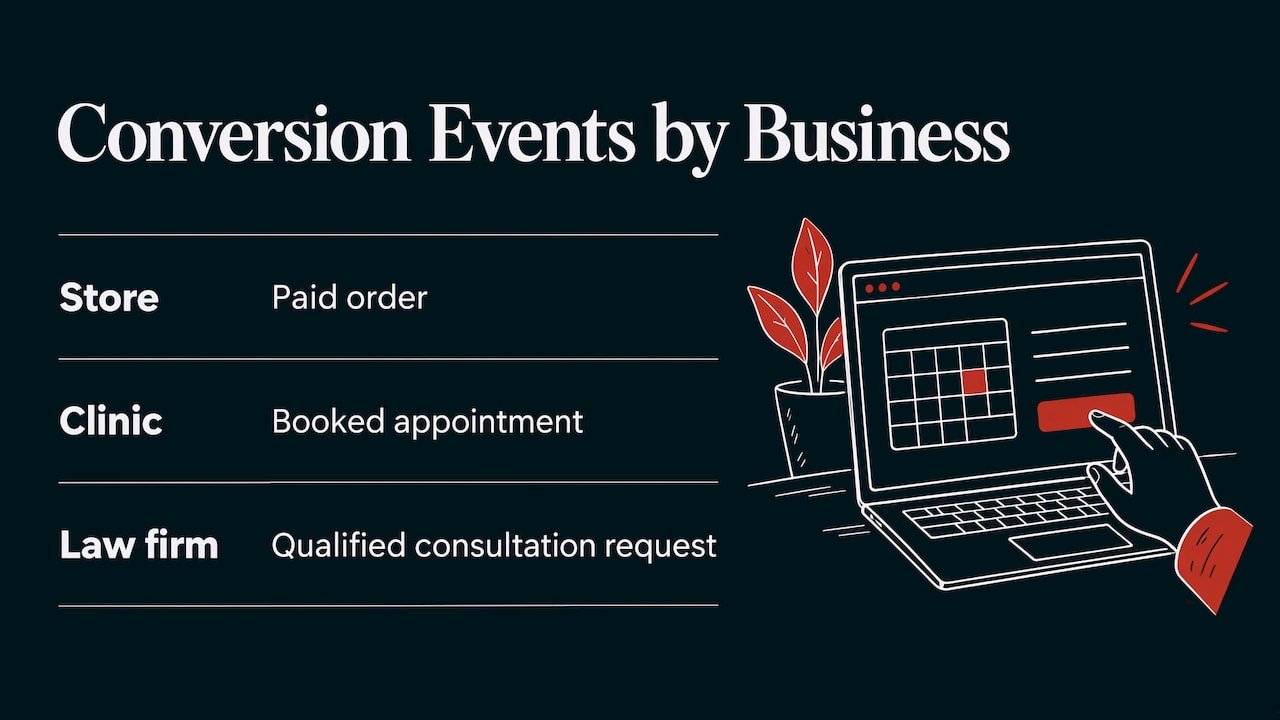
WooCommerce is not only for product catalogues. Clinics selling packages, law firms selling fixed-fee services, B2B suppliers with trade accounts and agencies building for their own clients all use the same pieces: a fast site, clear structure, search visibility and a short route to a booking or an order. The difference is the conversion event. For a store it is a paid order; for a clinic it is a booked appointment; for a law firm it is a qualified consultation request. The development brief should name that event first, then work backwards.
Promo: build, rank and convert in one engagement
If you are planning a WooCommerce store, a migration or a rebuild of one that underperforms, our team covers the development, the search work and the conversion programme under one roof. Start with the web development service and tell us what the store needs to achieve.
Our audits are grounded in real data and provided upfront, so the first conversation is about your numbers, not a template.
Our view on WooCommerce development
We build every campaign around how people in Dubai and Abu Dhabi actually search, and we apply that to WooCommerce stores from the first brief.
Our view is that development, SEO and conversion should never be separate projects. A store that is built well but not found, or found but not converting, has not done its job. That is why we combine technical development with customer behaviour analysis and continuous optimisation, and why we report honestly on what is moving revenue and what is not.
We also look ahead. Search is widening from Google results to AI-driven answers, so we structure product and category content for both. A store prepared for that shift keeps its visibility as buyer habits change.
the author
FAQ
How long does a WooCommerce development project take?
It depends on scope. A focused fix can be quick, while a full build with custom features, integrations and migration is a multi-week or multi-month engagement, which is how WooCommerce’s own guidance describes agency-scale work. A written scope with milestones gives you a realistic timeline for your store.
Do I need WooCommerce SEO if the store is already built?
A build does not make a store visible. Search work covers the technical set-up, category and product page content, structured data and bilingual keywords that decide whether buyers find you. Doing it alongside development avoids rework on URLs and templates.
Can WooCommerce development improve my conversion rate?
Yes, where the changes are based on evidence. Faster pages, a simpler checkout and clearer product information remove obstacles between a visitor and an order. Testing each change against your own data shows what made the difference.
Is a retainer or a one-off project better?
A one-off project suits a defined build or migration. A retainer suits SEO, paid advertising and continuous optimisation, where results build over months and the store needs regular updates and monitoring.
Does the work differ for law firms or clinics?
The platform skills are the same, but the goal changes from a paid order to an enquiry or booking. We shape page structure, trust content and forms around that goal.