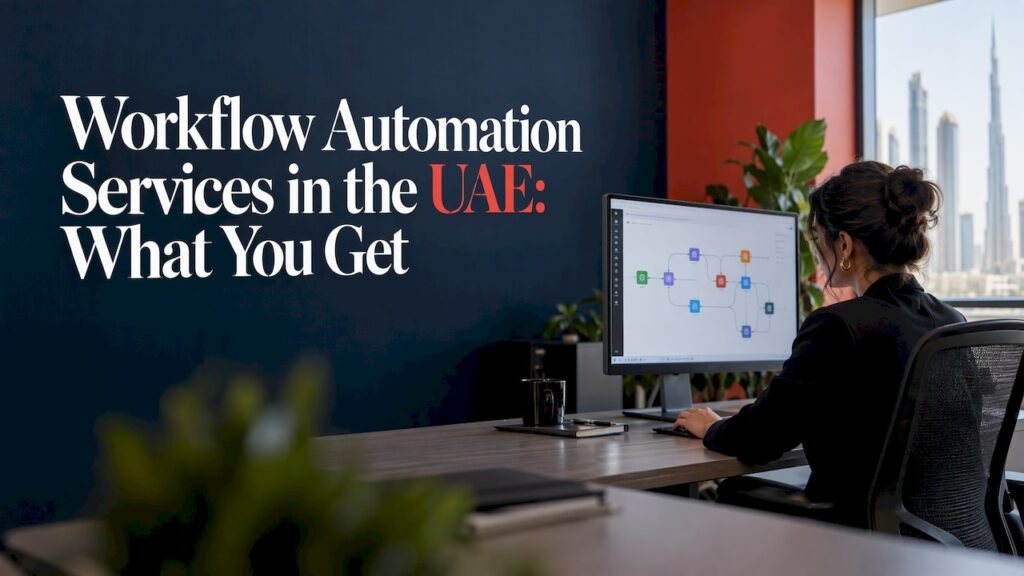
Workflow automation services replace repeated manual steps, such as copying data between systems, chasing approvals and sending routine messages, with software that runs those steps by rules you define. An agency audits your processes, picks the ones worth automating, connects your existing tools, builds and tests the flows, and maintains them afterwards. This guide explains what that looks like in practice for a business in Dubai or Abu Dhabi, which processes suit automation, what to check on data protection, and how to judge a provider.
TL;DR
- Workflow automation suits high-volume, repetitive, rule-based work with clear decision points. It does not suit processes that change every week or depend on judgement.
- A good engagement starts with a process audit, then moves through design, integration, testing, launch and ongoing maintenance.
- Your existing software usually stays. The work is connecting it so information moves between systems without retyping.
- If a workflow touches customer, employee or patient data, UAE personal data law applies, so plan consent, records and human review from the start.
- Judge a provider on how it scopes the work, handles exceptions and reports results, not on the number of tools it lists.
Table of Contents
- What workflow automation services cover
- Why UAE businesses are investing in it
- What a workflow automation agency actually does
- Which processes are worth automating
- Connecting the software you already have
- Example: automating clinic administration
- Data protection checks before you automate
- Costs, maintenance and return
- How to choose a workflow automation provider
- Our perspective
- Talk to us about automating your workflows
- FAQ
- Sources
What workflow automation services cover
A workflow is a sequence of tasks that moves work from one person or system to the next: an enquiry arrives, someone qualifies it, someone books a meeting, someone updates the CRM, someone sends a reminder. Automation takes the predictable parts of that sequence and runs them in software. Anything ambiguous goes to a person.
In practice, services fall into a few groups:
- Lead and enquiry handling. Form submissions, WhatsApp messages and calls are logged, routed to the right person and answered with a first response.
- Approvals and handoffs. Quotes, purchase requests, contracts and onboarding steps move between teams with reminders and a clear record.
- Data syncing. Orders, customers, invoices and appointments are passed between your website, CRM, accounting package and other tools.
- Reporting. Figures from several systems are pulled into one dashboard or weekly summary instead of being assembled by hand.
- AI-assisted steps. Classifying incoming messages, drafting replies for review, summarising documents or extracting fields from forms, always with a person checking the unclear cases.
The common thread is that the process is already understood. Automation makes a good process faster and more consistent. It will not repair a process nobody has defined.
Why UAE businesses are investing in it
Digital process adoption in the UAE is driven partly by government policy. Ken Research reports that the UAE’s Digital Government Strategy 2023 to 2025, issued by the TDRA, requires public sector entities to digitise processes under unified standards, and that this has accelerated workflow automation adoption. The same report values the UAE workflow management systems market at USD 900 million, with strong adoption in healthcare and finance.
For a private business, the practical consequence is that customers, partners and regulators increasingly expect fast, traceable responses. The same source estimates that, by implementing workflow management systems, companies can expect to reduce operating costs by up to 25%. Treat that as an upper-end market estimate, not a promise for your firm. Your own result depends on how much manual work you have today and how well it is scoped.
What a workflow automation agency actually does
Engagements differ by size, but a sensible one follows the same order.
1. Discovery and process audit
The agency maps how work currently moves: who does what, in which tool, how long each step takes and where it stalls. Good audits are grounded in real data, such as ticket counts, response times and the number of manual re-entries per week, rather than opinions. The output is a ranked list of candidate processes.
2. Scoping and prioritisation
Not every process is worth automating. The agency estimates the time saved, the error risk removed and the build effort, then proposes a first phase that is small enough to launch quickly and valuable enough to matter.
3. Design
This step defines triggers (what starts the workflow), rules (what happens next), data fields (what moves where), exceptions (what happens when something fails or is unclear) and owners (who is notified). Exceptions are where most poorly built automations fail, so a clear design names them in advance.
4. Integration and build
The flows are built and connected to your systems, using native integrations, APIs or middleware depending on what each tool supports. Where your website is part of the chain, development work on forms, tracking and data capture may be needed alongside the automation itself.
5. Testing
Each flow runs on sample and edge-case data before it touches live records. Testing covers duplicates, missing fields, unusual formats and what happens when a connected system is unavailable.
6. Launch, monitoring and maintenance
After launch, flows need monitoring. Software updates change fields, staff change processes and volumes grow. A maintenance arrangement, with alerts for failed runs and periodic reviews, keeps the automation reliable.
Which processes are worth automating
A process is a good candidate when it is frequent, repetitive, rule-based and has clear decision points. Use this table as a first screen.
| Process feature | Good candidate | Poor candidate |
|---|---|---|
| Volume | Dozens or hundreds of times a week | A few times a quarter |
| Rules | Same steps and conditions each time | Depends on judgement or negotiation |
| Data | Structured fields, consistent formats | Free-form, inconsistent, scattered |
| Systems | Two or more tools with manual copying between them | One tool, no handoffs |
| Error cost | Mistakes are costly and repeated | Mistakes are rare and easily caught |
| Stability | Process rarely changes | Process still being redesigned |
Examples that usually score well:
- Sending new website leads into your CRM with source information and assigning them to a salesperson.
- Automatic acknowledgement and follow-up messages after an enquiry.
- Invoice and order data moving from your online store to accounting.
- Onboarding checklists for new clients or staff.
- Internal approvals for purchase requests or discounts.
- Weekly performance reports compiled from several platforms.
Keep people in the loop
The best automations process the routine cases and pass the unusual ones to a person with the context attached. A flow that silently completes an ambiguous case is worse than no flow. When you scope a project, ask what happens to the cases that do not fit the rules, and who sees them.
Connecting the software you already have
Most businesses do not need new systems. They need the existing ones to talk to each other. A typical UAE company runs a website, a CRM, an accounting package, a messaging channel such as WhatsApp, a booking tool and a spreadsheet or two. Information stops at the edge of each.
Reliable connection rests on a few habits:
- Choose one source of truth per data type. Customer details live in one system and are copied from there, not edited in three places.
- Map fields before building. Decide how names, phone numbers, currencies, dates and statuses translate between tools. Phone number formats and Arabic and English name fields are common trouble spots in UAE data.
- Prefer event-based triggers. A flow that runs when something happens is faster and easier to trace than one that checks every hour.
- Log every run. You should be able to see what moved, when, and why a run failed.
- Alert on failures. A named person should be notified when a flow breaks, not discover it a week later.
- Document it. A one-page description of each flow means the knowledge does not sit with one developer.
Where a tool has no ready-made connector, an agency can use its API or build a small custom integration. This is where development skills matter as much as automation platform knowledge.
Example: automating clinic administration

Private clinics and dental practices carry a heavy administrative load: enquiries across web forms, calls and WhatsApp, appointment booking, insurance questions, reminders and no-show follow-up. Much of it is rule-based, which makes it a strong fit.
A realistic first phase for a clinic might include:
- Capturing every enquiry from the website, social channels and messaging into one inbox or CRM, with the source recorded.
- Sending an instant acknowledgement with the next step, in English or Arabic depending on the patient.
- Offering booking against the practitioner’s real availability.
- Sending appointment reminders and a simple way to confirm or reschedule.
- Following up with patients who missed or cancelled an appointment.
- Routing complex or sensitive questions to the front desk, with the conversation attached.
The design principle is to automate the operational layer, such as appointment times, contact details and reminders, and keep clinical information inside the clinic’s own records system. The automation passes only what it needs. Health data is sensitive, so check your obligations before connecting any channel, as set out in the next section.
The same logic applies to law firms (intake forms, conflict-check prompts, consultation booking, document requests) and to e-commerce brands (order updates, abandoned-cart messages, stock alerts, returns handling).
Data protection checks before you automate
If a workflow handles customer, employee or patient data, the UAE’s federal personal data law applies. Federal Decree-Law No. 45 of 2021 sets out several duties that bear directly on automation design:
- Lawful, specific purpose and data minimisation (Article 5). Personal data must be processed fairly, transparently and lawfully, for a specific and clear purpose, and limited to what is necessary. In practice, do not pipe every field into every tool. Send each system only what it needs.
- Security measures and records (Article 7). Controllers must take appropriate technical and organisational measures and maintain a special personal data record. A documented map of your flows helps here.
- Data Protection Officer (Article 10). One must be appointed when the specified conditions apply. Check whether yours do.
- Human review of automated decisions (Article 18). The law includes a human element in reviewing automated-processing decisions at the data subject’s request. Design flows so a person can review and override an outcome.
- Risk assessment (Article 21). High-risk processing using modern technologies in the cases specified calls for an assessment before it starts. AI-driven steps that profile or classify individuals are worth raising with your legal adviser.
These are the points the law raises, not a full compliance review. For anything involving health records, financial data or cross-border transfers, speak to a qualified UAE data protection lawyer, and check whether sector rules for your industry add further requirements.
Costs, maintenance and return
Workflow automation is priced in one of two ways: a project fee for a defined build, or a retainer that covers building, monitoring and extending flows. Costs rise with the number of systems, the complexity of the rules and how much custom integration is needed. Be wary of any quote given without a look at your processes.
Budget for three things:
- Build. Design, integration, testing and launch.
- Software. Subscriptions or licences for the automation platform and any connected tools.
- Maintenance. Monitoring, fixes when connected tools change, and extensions as your business grows.
To estimate return, use your own numbers rather than industry headlines:
- Count how many times the process runs per month.
- Time how long each run takes by hand, including corrections.
- Multiply by the loaded hourly cost of the person doing it.
- Add the cost of errors, such as lost leads, late invoices or missed appointments.
- Compare the total with the build, software and maintenance costs over twelve months.
For example, a task that takes eight minutes and runs 600 times a month uses 80 hours of staff time monthly. If automation removes most of that and sends the rest to a person as exceptions, the saving is visible within a quarter. A process that runs ten times a month rarely pays back, however impressive the technology.
Also count the benefits that are harder to price: faster replies to new enquiries, fewer dropped handoffs and cleaner data for reporting.
How to choose a workflow automation provider
Use these questions in your first conversation.
| Question | What a strong answer looks like |
|---|---|
| How do you decide what to automate? | A data-based audit of your processes, with a ranked shortlist |
| What happens when a flow fails or a case is unusual? | Defined exception handling, alerts and a named owner |
| Do you work with our existing systems? | A plan to connect them, not a default recommendation to replace them |
| Who owns the flows and documentation? | You do, with clear handover documents |
| How do you handle personal data? | Specific answers on minimisation, access, records and human review |
| How is progress reported? | Clear metrics agreed upfront, reported honestly |
| Who maintains the flows after launch? | A defined support arrangement |
Also look for sector understanding. A provider that already knows how law firms, clinics or online stores operate in Dubai and Abu Dhabi will scope faster and avoid obvious mistakes, such as ignoring bilingual enquiries or WhatsApp as a primary channel.
Our perspective
Most automation projects that disappoint were not held back by the software. They started with the tool and worked backwards to a process. We work the other way round: we audit how work really moves, using your data, and automate only what the numbers support.
Our focus is on the UAE market, and that shapes the work. Enquiries arrive in English and Arabic, WhatsApp is often the first point of contact, and sectors such as law, healthcare, e-commerce and professional services each have their own handoffs and sensitivities. We build around those realities instead of reusing a generic template.
We also treat automation as part of growth, not a separate IT task. The same website that captures a lead should pass it cleanly into your CRM, trigger the right follow-up and feed the reporting that tells you which marketing spend is working. Because we also build websites and run conversion optimisation and paid advertising, we can see the whole path from first click to booked consultation and fix the weak link instead of only the part we were hired for.
Our reporting is meant to be plain and honest: what was built, what it does, what it saves and where it needs attention.
the author
Talk to us about automating your workflows
Foureyes Solutions offers AI workflow and automation services for businesses in Dubai, Abu Dhabi and beyond. We start with an audit grounded in your real data, then connect the tools you already use and build flows around the processes that will save the most time. If your website is part of the chain, our web development team can handle forms, tracking and integrations in the same project, and our conversion rate optimisation work helps make sure the leads you capture are worth following up. You can see the full range on our services overview.
FAQ
What is the difference between workflow automation and robotic process automation?
Workflow automation coordinates a sequence of tasks between people and systems, including approvals, handoffs and notifications. Robotic process automation usually mimics clicks and keystrokes in a screen, often where no integration is available. Many projects combine both, but where a system offers an integration, connecting it directly is generally more stable.
How long does a workflow automation project take?
It depends on the number of systems and the complexity of the rules. A single, well-defined flow, such as routing website leads into a CRM with follow-up messages, is much quicker than a multi-department programme. Most agencies recommend a small first phase so you see results before committing to more.
Do we need to replace our current software?
Usually not. The main task is connecting the tools you already use so information moves between them without retyping. Replacement only makes sense when a tool cannot be integrated or no longer fits how you work.
Is it safe to automate processes that involve patient or client data?
It can be, provided the design respects UAE personal data law: collect only what you need, keep records, secure access and allow human review of automated outcomes. Health and legal data are sensitive, so involve your legal adviser and check any sector-specific rules before launch.
Can small businesses benefit, or is it only for large companies?
Smaller businesses often see the clearest gains because a few repeated tasks consume a large share of a small team’s time. The test is volume and repetition, not company size. If a task runs dozens of times a week and follows clear rules, it is worth reviewing.
Sources
- UAE Workflow Management Systems Market, Ken Research (November 2025)
- Federal Decree-Law No. 45 of 2021 on the Protection of Personal Data, UAE Legislation portal