SEO services in the UAE cover technical fixes, content, local search, Arabic and English targeting and reporting, all aimed at bringing qualified enquiries from Google and, increasingly, from AI answers. The best fit is a team that builds the work around Dubai and Abu Dhabi search behaviour and ties it to enquiries or sales, not to rankings alone. That is how we approach it at Foureyes Solutions: audits grounded in real data, provided upfront, then continuous optimisation.
This guide is for business owners and marketing managers in the UAE: e-commerce brands, law firms, clinics, B2B and professional services companies, and agencies that need technical SEO support. It explains what you are buying, what a campaign looks like, what moves the price and how to judge a proposal.
TL;DR
- SEO services bundle technical SEO, on-page work, content, local SEO, link building and reporting. Ask which of these your site needs first, not which package is longest.
- In the UAE, bilingual search behaviour, local intent in Dubai and Abu Dhabi and mobile speed shape the work more than generic global templates do.
- Agency, company and consultant are mostly different labels for different team sizes. What matters is who does the work and how it is reported.
- Google says SEO changes can take months to show. Plan on a horizon of four to twelve months and judge progress by enquiries, not only by positions.
- Price depends on competition, site size, languages and how much content and technical work is needed. A data-led audit tells you the real scope.
Table of Contents
- What SEO services in the UAE actually include
- Agency, company or consultant: what the labels mean
- What a UAE SEO campaign looks like, step by step
- Why the UAE market needs its own approach
- What affects the price of SEO services in the UAE
- How long SEO takes to show results
- What to look for in a proposal
- SEO for specific sectors
- Our perspective
- Work with us on SEO in Dubai and Abu Dhabi
- FAQ
- Sources
What SEO services in the UAE actually include
Search engine optimisation (SEO) is the work of making your website easier for search engines to understand and more useful to the people searching. Proposals use different names for the same building blocks, so it helps to know them.
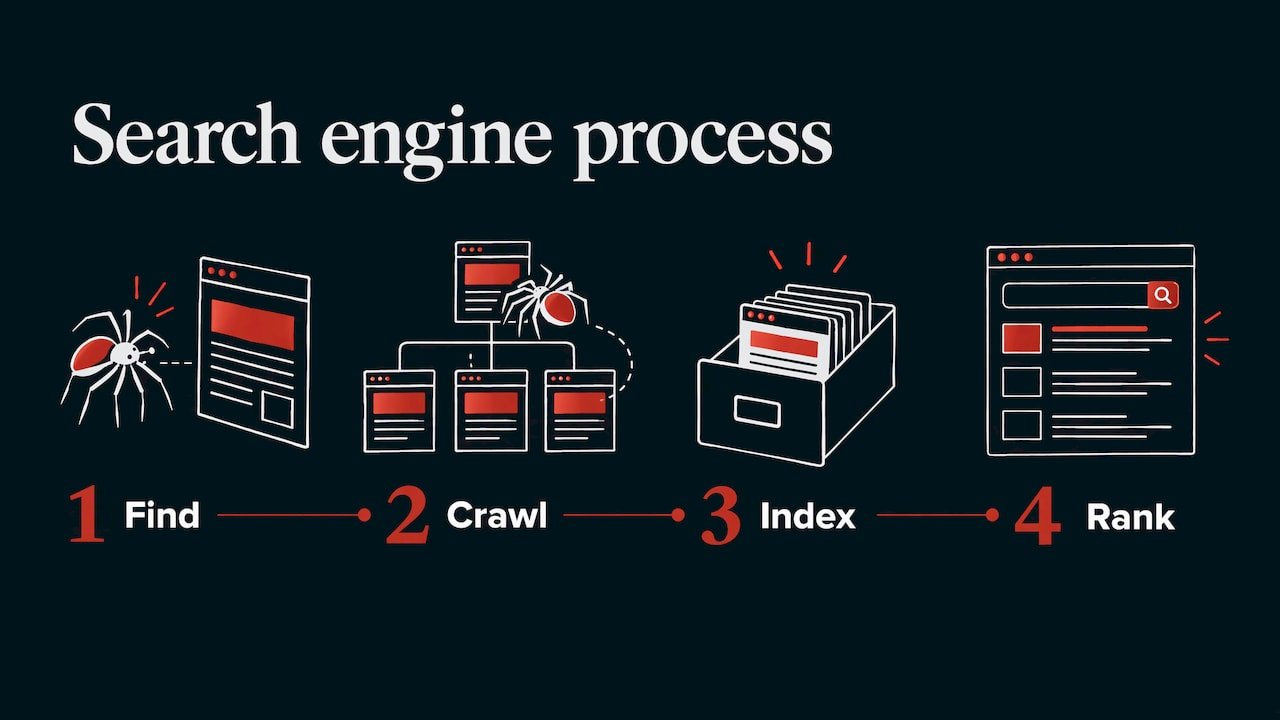
Technical SEO. Crawlability, indexing, site structure, page speed, mobile rendering, structured data and fixing errors that stop pages appearing at all. Google’s own guidance explains that search engines need to find, crawl and index your pages before they can rank them, so this is the foundation.
On-page SEO. Page titles, headings, copy, internal links and images, matched to what a searcher in your market actually types. A Dubai dental clinic and a Dubai logistics firm search very differently, and the pages must reflect that.
Content SEO. Service pages, guides and comparison pages that answer buyer questions. For law firms and clinics, this is usually where qualified enquiries come from, because people research before they call.
Local SEO. Ranking for searches with a place attached: “near me”, an area such as Business Bay or Al Reem Island, or a city name. It centres on your Google Business Profile, local pages, reviews and consistent business details.
E-commerce SEO. Category and product page optimisation, faceted navigation, product schema and speed on Shopify or WooCommerce stores.
Link building and digital PR. Earning mentions from relevant, credible sites so search engines treat your site as an authority.
Reporting. Monthly or quarterly figures on traffic, rankings, enquiries and revenue. Honest, transparent reporting is the part that lets you judge the other six.
AI search visibility (GEO). Generative Engine Optimisation is the practice of making your brand and pages easy for AI answer tools to find and cite. It builds on strong SEO rather than replacing it. If this matters to you, our GEO service and our guide to hiring a GEO agency in Dubai go deeper.
Agency, company or consultant: what the labels mean
People search for an SEO agency, an SEO company and an SEO consultant almost interchangeably. In practice the difference is in who does the work.
| Type | Typical set-up | Works well when |
|---|---|---|
| Consultant | One senior person who advises and audits, often leaving execution to your team | You have in-house developers and writers who can implement |
| Agency or company | A team with technical SEO, content, development and reporting under one roof | You want the work done, not just directed |
| Agency with development in-house | SEO plus web development, CRO and paid media together | Fixes need code changes, and you want search traffic to convert |
The third row matters more than it looks. Many SEO recommendations (faster templates, cleaner navigation, new page types) need a developer. When SEO and development sit together, fixes ship instead of waiting in a backlog. We build on WordPress, Shopify and WooCommerce as well as custom and headless platforms, so technical recommendations are carried out by the same team that made them. You can see the range on our web development page.
What a UAE SEO campaign looks like, step by step
Campaigns differ, but a sound one follows the same order. Here is each step, what it takes and where it commonly goes wrong.
1. Audit and baseline
The audit covers technical health, content, backlinks, competitors and current search visibility. It should be built on real data from your own analytics and search console, not a generic checklist. Where it goes wrong: a templated audit that lists hundreds of minor warnings without ranking them by commercial impact. Our audits are grounded in real data and provided upfront, so you see the findings before committing to a long engagement.
2. Keyword and intent research
This maps the searches your buyers use to pages on your site. In the UAE, that means checking English and Arabic terms, transliterated terms, and the difference between a resident searching for a service and an overseas buyer searching for a supplier. It goes wrong when volume is chased over intent: a keyword with 5,000 searches that never converts is worth less than one with 50 that brings a client.
3. Technical fixes
Speed, indexing, structure, schema and mobile experience come first because every later step depends on them. Mobile speed is a real commercial issue for UAE stores: our headless commerce case study from Dubai shows how a platform change cut load time.
4. On-page and content production
Existing pages are rewritten for intent, and new pages fill the gaps. Each page should have one clear job and one next step for the visitor, such as booking a consultation or adding to basket. It goes wrong when content is written for algorithms and reads like it, or when it is translated word for word instead of written for the Arabic reader.
5. Local SEO set-up
Google describes local results as based mainly on relevance, distance and prominence. So the work is a complete and accurate Business Profile, location pages with real local detail, reviews and consistent contact details across directories.
6. Authority building
Relevant links and mentions from industry publications, associations and credible local sites. It goes wrong when links are bought in bulk from unrelated sites, which can put a site at risk. Fewer, relevant links beat many weak ones.
7. Reporting and iteration
SEO is not a one-off project. Rankings shift, competitors publish and search features change. Monthly reporting should connect search work to leads and revenue, and each month should end with a clear list of what happens next.
Why the UAE market needs its own approach
A template that works in London or Sydney does not transfer cleanly to Dubai or Abu Dhabi. Three differences stand out.
Bilingual search. Many UAE searchers use English, Arabic or both, depending on the product and the person. Google recommends separate URLs for each language version with proper annotations so the right version reaches the right searcher. A common set-up is language folders such as /en/ and /ar/, and the technical checks include right-to-left layout, Arabic fonts, mobile usability and page speed. Whether Arabic pages are worth building first depends on your audience: a luxury property agency and a B2B industrial supplier will answer that differently.
Local intent by emirate and neighbourhood. A search in Dubai often means a specific area. Pages that name the area and its real context outperform a single generic “Dubai” page.
Sector competition. Law, real estate, healthcare and e-commerce are crowded in the UAE. We focus on sectors such as law, e-commerce, real estate and professional services, which means the keyword research, page structure and enquiry flow start from how those buyers behave.
What affects the price of SEO services in the UAE
Prices vary widely between providers, and a monthly figure is meaningless without a scope. These factors set the real cost:
- Competition. Ranking for a high-value legal or property term takes more content and more authority than a niche B2B term.
- Site size and condition. A 20-page brochure site and a 5,000-product store are different jobs. A site with serious technical debt needs a heavier first phase.
- Languages. Arabic and English versions roughly double the content and testing work.
- Locations. One office is simple. Several branches across emirates need separate local pages and profiles.
- Content volume and quality. Specialist content (legal, medical) takes more research and review than general copy.
- Development needs. If fixes need a rebuild or custom work, that sits alongside the SEO fee.
- Reporting and strategy depth. A senior strategist adds cost and changes outcomes.
We do not publish a fixed price list for SEO, because the audit decides the scope. You can get a starting estimate with our SEO budget estimator, and our article on how much SEO costs in Dubai explains the ranges and trade-offs in more detail.
How long SEO takes to show results
Google’s guidance says that SEO changes usually take months to have a visible effect, often between four months and a year, depending on the site and the competition. Treat that as the honest range.
A realistic pattern for a UAE business:
- Month 1 to 2: audit, research, technical fixes begin. Little visible movement.
- Month 3 to 4: improved pages get indexed, early gains on lower-competition terms and local searches.
- Month 5 to 8: content and authority compound. Enquiries from organic search start to rise on priority terms.
- Month 9 onward: growth on competitive terms, and the data is rich enough to guide further decisions.
Two things speed up the return. The first is fixing technical blockers early. The second is conversion rate optimisation (CRO), the practice of improving how many visitors become enquiries or orders. If your site converts at a higher rate, every extra visitor from SEO is worth more. That is why we treat conversion rate optimisation and SEO as one growth programme: SEO brings people in, CRO makes the visit count.
What to look for in a proposal
Use these questions when you read proposals, from any type of provider:
- Is the scope specific? It should list deliverables (pages, fixes, links, reports), not just “SEO optimisation”.
- Is the audit based on your data? It should reference your analytics and search console, not only a crawler export.
- Does it cover both languages if you need them? Arabic content should be written, not machine-translated.
- Are goals tied to enquiries or revenue? Rankings are a means, not the outcome.
- Is the timeline honest? Anyone promising page one in weeks for a competitive term is promising something search engines do not allow anyone to guarantee.
- Who does the work? Find out whether you get a senior strategist or only a salesperson and a junior team.
- Can fixes be built? Check that development sits with the same team, so technical recommendations are implemented.
- Is the reporting plain? You should be able to read it without a glossary.
SEO for specific sectors
Law firms. Searchers look for a practice area plus a city, and they compare firms before calling. Practice-area pages, lawyer profiles, local signals and a clear consultation booking path matter most.
Clinics and dental practices. Local search and reviews drive most new-patient discovery. Treatment pages, accurate profiles and an easy booking form turn visits into appointments.
E-commerce brands. Category pages carry most of the opportunity. Speed, clean faceted navigation, product schema and strong product copy on Shopify or WooCommerce are the core work, together with CRO to lift conversion and average order value.
B2B and professional services. Longer sales cycles reward authority content and lead generation funnels that capture the enquiry, not just the visit.
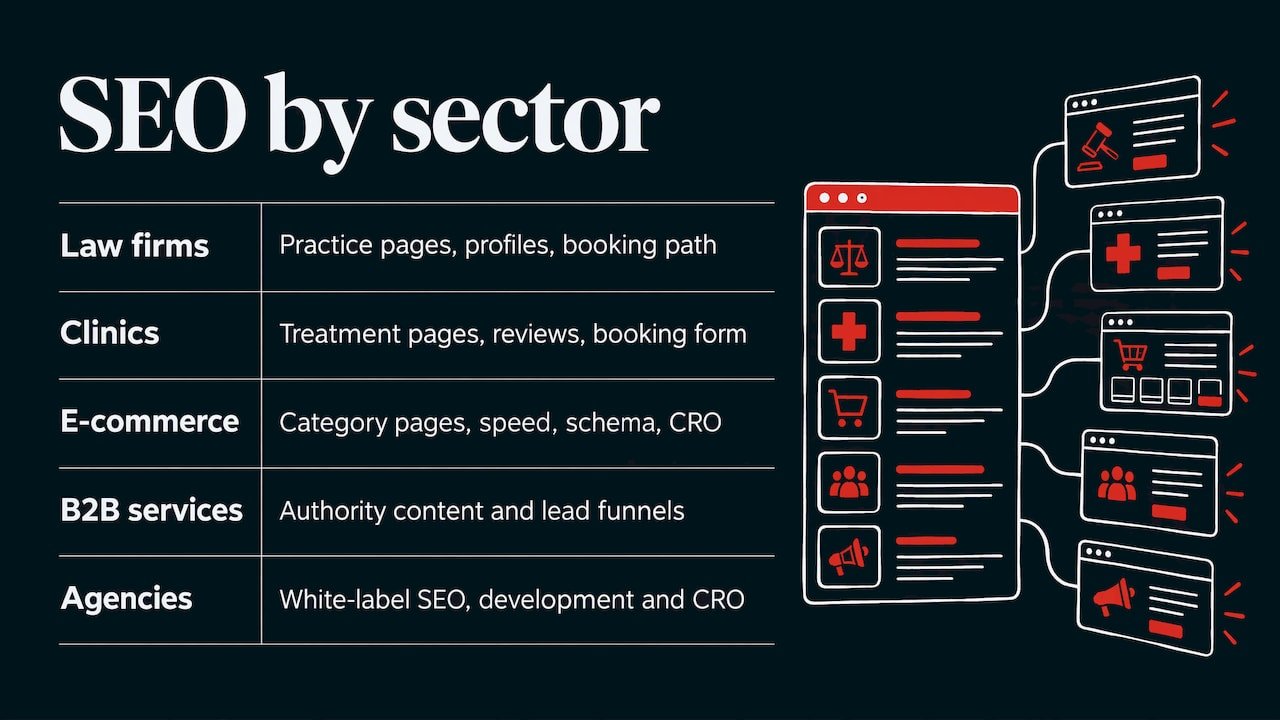
Agencies. If you resell SEO, white-label technical SEO, development and CRO support can extend your delivery without adding headcount.
Our perspective
We see too many UAE businesses buy SEO as a monthly line item and judge it by a ranking report. We think that is the wrong measure.
Search in Dubai and Abu Dhabi is bilingual, local and highly competitive. A campaign has to be built around how people in these markets actually search, not adapted from a global template. That is why we start with an audit grounded in your own data and give it to you upfront.
We also believe SEO works best when the people who recommend a fix can build it. Technical SEO, web development, conversion optimisation and AI search visibility belong in the same plan, because visibility without conversion is wasted spend, and a fast, well-built site without visibility is invisible.
Our reporting is meant to be plain and honest: what was done, what moved, what we do next.
the author
Work with us on SEO in Dubai and Abu Dhabi
If you want an SEO plan built around your market, sector and data, our team can start with the audit. We cover SEO, GEO, CRO, web development on WordPress, Shopify and WooCommerce, and paid advertising on Google and Meta, so your search, site and conversion work run together. See our SEO services in Dubai and Abu Dhabi or get in touch through our site.
FAQ
How much do SEO services cost in the UAE?
Cost depends on competition, site size, languages, locations and how much content and technical work is needed, so any single figure without a scope is unreliable. Our SEO pricing breakdown for Dubai explains the factors, and the SEO budget estimator gives a starting point for your case.
How long before SEO shows results?
Google says SEO changes can take months to show, commonly between four months and a year. Early gains on local and lower-competition searches often come first, with competitive terms following as content and authority build.
Do I need Arabic as well as English SEO?
It depends on who you want to reach. If your customers search in Arabic, Arabic pages written for that audience and set up correctly with language annotations can open a segment that English-only sites miss. Start with the language your highest-value customers use, then expand.
What is the difference between SEO and GEO?
SEO aims to rank your pages in search results. GEO, or Generative Engine Optimisation, aims to make your brand and content easy for AI answer tools to find and cite. Both rely on clear structure, credible content and technical health, so they work best as one plan.
Is local SEO enough for a business in Dubai or Abu Dhabi?
For businesses serving customers in a specific area, such as clinics, law offices and restaurants, local SEO is the core. Most also gain from service and content pages that capture research searches before a customer chooses where to go.
Sources
- Google Search Central: SEO Starter Guide
- Google Business Profile Help: Improve your local ranking on Google
- Google Search Central: Managing multi-regional and multilingual sites
- Google Search Central: Do you need an SEO?
- Newsideainsight: Bilingual SEO UAE