
To automate customer support well, start with a month of your real tickets, automate the repetitive, low-risk requests first, and design a clean hand-off to a person for everything else. Judge the result by how many problems were actually resolved, not by how many chats a bot closed. For businesses in Dubai and Abu Dhabi, where customers switch between English and Arabic and expect fast replies on WhatsApp, email and web chat, that order matters even more. Our AI workflows and automation service is built around this approach: map the work, connect the systems, then automate.
This guide is for owners and marketing or operations managers at e-commerce brands, law firms, clinics, B2B and professional services companies, and agencies. It covers what customer support automation is, what to automate, how to roll it out, the risks, and how to measure it.
TL;DR
- Customer support automation is more than a chatbot. It is a set of rules and AI steps that route, answer and complete requests behind the scenes.
- Automate requests that are frequent, predictable and low-risk: order status, appointment changes, password resets, policy questions, triage and after-hours capture.
- Keep people on complaints, disputes, exceptions, vulnerable customers and anything the system cannot ground in approved information.
- Build the hand-off first: the person who takes over should see the full history, so the customer never repeats themselves.
- Measure resolution, repeat contact and escalation quality. Deflection and chat length alone can flatter a poor system.
Table of Contents
- What customer support automation actually is
- Start with a month of real tickets
- What to automate and what to keep human
- A step-by-step rollout
- Risks to plan for in the UAE
- How to measure whether it works
- Where automation meets your website and search visibility
- Our perspective
- Plan your first automated workflow with us
- FAQ
- Sources
What customer support automation actually is
Customer support automation uses software rules, AI and connected systems to handle, route or complete customer requests with less manual effort. It has four working parts:
- Understanding the request. AI reads the message and works out what the customer wants, in English, Arabic or a mix of both.
- Rules and routing. Workflows follow a simple pattern: a trigger (a new ticket arrives), a condition (it mentions a refund over a set value) and an action (send it to a senior agent).
- Self-service answers. The customer gets an answer drawn from your help content, policies or price lists.
- Actions in your systems. The workflow updates a CRM record, books a slot, starts a return or tags a ticket.
The last part is where most businesses stop short. A chatbot only produces a message in a conversation. Workflow automation changes something in your business: a status, a booking, a ticket queue. Answering “where is my order?” is useful. Looking up the order, checking the courier status and replying with the right answer, without an agent touching it, is the real saving.
If you are comparing terms, “customer service workflow automation” usually means this second layer: the multi-step processes behind the conversation, such as refunds, returns, rescheduling and account changes. Support automation in the narrow sense often refers to post-purchase issues. Service automation covers the whole journey, including pre-sales questions and onboarding. For most UAE businesses the practical question is the same: which steps can run without a person?
Start with a month of real tickets
Before choosing any tool, export 30 days of enquiries from every channel: email, web chat, WhatsApp, contact forms and phone notes. Then do the following.
- Group them by reason. Delivery status, appointment change, invoice request, pricing question, complaint, and so on. Ten to fifteen groups is usually enough.
- Count each group. Volume tells you where the saving is.
- Note the source of truth. Where does the correct answer live: your order system, calendar, a policy page, a person’s head?
- Note the cost of being wrong. A wrong delivery estimate is an annoyance. A wrong refund, a wrong legal statement or wrong medical advice is a problem.
- Mark the language. How many requests arrive in Arabic, English or both?
This exercise often shows that a small number of request types make up most of the volume, and that some of your “support” load is really missing information on your website. In that case the fastest fix is better content or a clearer page, which is why support automation and conversion rate optimisation overlap: a question asked fifty times a week is often a gap in the page the customer was reading.
Then choose one pilot workflow. A good pilot has a clear start and end, a known owner, reliable information behind it and a defined list of what is out of scope. Write down what the pilot will not handle, and what happens when a record is missing, two sources disagree or the request falls outside the rules.
What to automate and what to keep human
A request is a good candidate when it has four traits: high volume, predictable structure, a verifiable answer and a low cost of being wrong. Use the grid below as a starting point and adjust it to your sector.
| Request type | Examples | Best handling |
|---|---|---|
| Low stakes, high frequency | Order or delivery status, password resets, invoice downloads, opening hours, policy FAQs | Fully automated |
| Routine process, clear rules | Returns within policy, appointment booking and rescheduling, subscription changes, address updates | Automated workflow with rules and a human fallback |
| Needs context, then a person | Billing disputes, damaged-item claims, troubleshooting, case enquiries | Automation collects details and routes; a person resolves |
| High stakes or emotional | Complaints, refund exceptions, cancellations and retention, VIP clients, legal or regulatory complaints, security incidents | Human first, with AI preparing the summary |
A few examples by sector show how this works in practice.
E-commerce on Shopify or WooCommerce. Order tracking, return initiation, size and delivery questions, and cash-on-delivery confirmation are strong candidates. A refund exception for a repeat customer is not. Automation can still draft the context for the agent.
Law firms. Automate intake: capture the matter type, jurisdiction, urgency and contact details, offer consultation slots and send confirmations. Do not let an automated system give legal advice. Anything about the substance of a case goes to a lawyer.
Clinics and dental practices. Appointment booking, reminders, rescheduling, directions and pre-visit instructions suit automation. Symptoms, clinical questions and distressed patients go to staff straight away.
B2B and professional services. Qualify enquiries, route them by service line and book calls. Contract and pricing negotiation stays with your team.
Two rules keep this safe. First, anything the system cannot ground in approved content should not be answered by it. Second, a request that looks routine can still need a person: a billing error is a workflow, but the same error on an account that has already complained twice is a retention conversation. Build “explicit request for a person” and “repeat contact” as automatic triggers to escalate.
A step-by-step rollout
1. Triage first
Automated triage is the safest first step. The system reads each incoming message, tags the topic, language and urgency, and routes it to the right queue or person. Nothing is sent to the customer that you have not approved, so the risk is low, and agents save the time they used to spend sorting.
2. Add drafted replies for agents
Next, let AI draft replies that an agent reviews and sends. You get faster responses and learn where the drafts are weak before any customer sees an unreviewed answer.
3. Add answers grounded in your own content
Self-service answers should come only from approved sources: your help centre, policy pages and price lists, kept current and without duplicates. Show the customer where the answer came from. Where the system is not confident, it should hand over rather than guess.
4. Connect the systems that hold the answers
This is the step that moves you beyond FAQs. Connect the support layer to your order system, CRM, booking calendar, billing or ticketing tool, so the workflow can look up and change records. A typical sequence is:
- Understand what the customer wants.
- Collect the missing details.
- Verify who they are and apply your business rules.
- Call the relevant system.
- Check that the action worked.
- Confirm to the customer, or escalate.
For consequential steps such as refunds, eligibility checks and approvals, keep the rules explicit and fixed rather than leaving them to open-ended AI generation. Let AI interpret the language, and let a controlled workflow carry out the decision.
5. Design the hand-off
The hand-off decides whether customers trust the rest. When a conversation moves to a person, that person should receive the full request, the history and what the system has already done. The UAE’s own approach to agentic AI in government services reflects this: the National Committee for Agentic AI’s guide, reported by Khaleej Times in August 2026, includes a smooth transition to a specialist employee with all request details passed on, so the customer does not explain again. It also covers getting customer approval before an action and preserving privacy. Those are sensible standards for a private business too.
6. Expand gradually
Once the first workflow runs reliably, add the next one from your ticket groups. Each new workflow gets its own scope, owner and stop condition.
Risks to plan for in the UAE
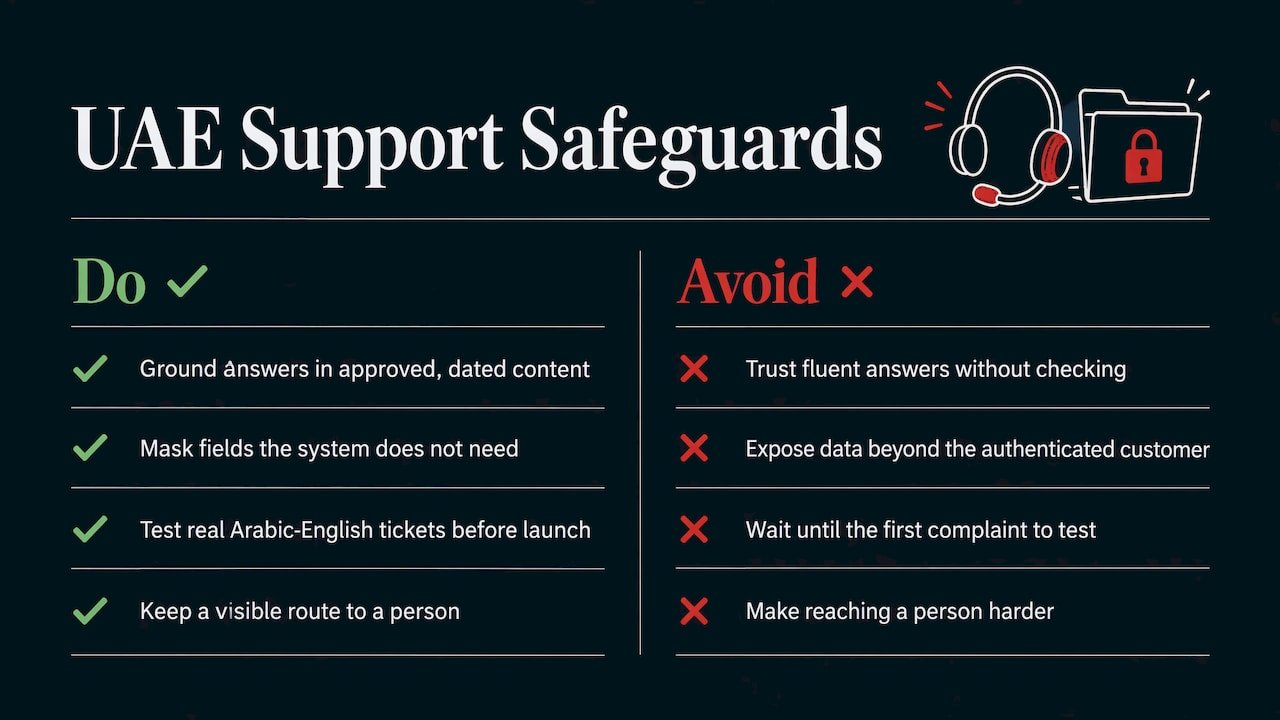
Confident wrong answers. AI can deliver a wrong answer as smoothly as a right one, and a satisfied customer score can hide the error. Ground answers in dated, approved content, remove outdated duplicates, and set a confidence threshold below which the system hands over.
Personal data. Support conversations contain names, phone numbers, order details and sometimes health or legal information. The UAE’s Personal Data Protection Law, Federal Decree Law No. 45 of 2021, applies to processing of personal data through electronic systems and generally requires the owner’s consent, with limited exceptions. It came into force on 2 January 2022. Practical steps: let the system see only the authenticated customer’s data, mask fields it does not need, and keep a log of what was retrieved. Free zones such as DIFC and ADGM have their own data regimes, and sector rules apply to healthcare and legal data, so confirm the position for your entity with your legal adviser or data protection officer.
Language and tone. Arabic and English, and the mix of the two in a single WhatsApp message, need testing with real examples from your own tickets, including dialect, transliteration and formal versus casual register. Test before launch, not after the first complaint.
Hidden friction. If automation makes it harder to reach a person, customers leave. Always keep a visible route to a human, and act at once when someone asks for one.
How to measure whether it works
The most common mistake is celebrating deflection: the share of conversations that did not reach an agent. A customer who gives up also counts as deflected. Use a short scorecard instead:
| Measure | What it tells you |
|---|---|
| Resolution rate | Was the problem actually solved? |
| Repeat contact within 7 days | Did the customer have to come back? |
| Reopen rate | Did tickets marked solved return? |
| Escalation rate and quality | Too low can mean wrong answers are being accepted; too high can mean gaps in your content. Did the person receive full context? |
| Satisfaction by path | How do customers rate automated handling versus human handling? |
| Human minutes and cost per contact | Did the work really leave the team? |
Set a baseline from your month of tickets before launch. Run the pilot against that baseline for a fixed period. Then decide: expand, adjust or pause. Agree the stop conditions in advance, such as a rise in repeat contacts or a wrong-answer report on a sensitive topic. A short interaction is not automatically a good one, so review a sample of conversations each week.
Where automation meets your website and search visibility
Support automation does not sit apart from marketing. Customers increasingly ask questions in search engines and AI assistants before they contact you, and the same content that answers them there can feed your support answers. A clear help centre, accurate service pages and consistent policies serve three jobs: they reduce tickets, ground your automated answers and give search and generative engine optimisation something reliable to work with. Treat support questions as a content brief for your site.
For a closer look at what a workflow engagement covers, our guide to workflow automation services in the UAE walks through the deliverables.
Our perspective
Most businesses we speak to want a chatbot. What they need is a working workflow. The chat window is the visible part, and the value sits behind it: the connections to your order system, calendar, CRM and ticketing tool, and the rules that decide what happens next.
Our approach combines technical expertise, customer behaviour analysis and continuous optimisation. We start from the data: your tickets, your site behaviour and your customers’ language in Dubai and Abu Dhabi, not a template from another market. Audits are grounded in real data and provided upfront, and our reporting is honest and transparent, so you can see what was resolved and what was not.
Support automation also improves the website. When we see the same question repeated, it points to a page that needs work, which is where our CRO and SEO teams come in. That joined-up view of how customers are discovered, how they convert and how they are served is why we build support automation as part of a wider digital growth plan rather than as a stand-alone tool.
the author
Plan your first automated workflow with us
If you have a month of tickets and one workflow in mind, you are ready to start. Foureyes Solutions delivers AI workflow and automation projects for businesses in the UAE, alongside website development for WordPress, Shopify and WooCommerce, so the support layer and the site it depends on can be built together. Start with our AI Workflows and Automation page, or go to our homepage to see the full range of services.
If your support questions are driven by website gaps, our web development team can fix the pages as well as the process.
FAQ
Can small businesses automate customer support?
Yes, and often the gains are quickest there. Start with one repeatable request type, such as appointment changes or order status, and automate only that. A single well-scoped workflow with a clear hand-off will do more for you than a broad chatbot that tries to answer everything.
Will customers accept automated support in Arabic and English?
They accept it when it solves the problem quickly and lets them reach a person when needed. Test the system on real messages in both languages, including mixed-language messages, before launch. Keep a visible route to a human on every channel.
Which customer service tasks should never be fully automated?
Keep people on complaints, refund exceptions, cancellations and retention conversations, billing disputes, legal or regulatory complaints, security incidents and anyone who asks for a person. For clinics and law firms, anything involving clinical or legal advice also stays with a qualified professional.
How long does it take to see results?
It depends on the workflow and the systems behind it, so there is no fixed figure. Set a baseline before launch and compare resolution, repeat contact and human minutes over a fixed pilot period. Then decide whether to expand.
Is customer data safe in automated support?
It can be, if you design for it. Limit the system to the authenticated customer’s data, mask fields it does not need, log retrievals and follow the UAE Personal Data Protection Law. Check your free zone or sector rules with your legal adviser.
Sources
- UAE launches unified guide for designing government services with agentic AI, Khaleej Times
- Data protection laws, UAE Government portal