
AI business automation means using AI inside your everyday workflows so that software reads, sorts, drafts and routes work that your team currently handles by hand. For a UAE business the question is rarely whether to start. It is which process to start with, how much autonomy to give it and how to prove it pays back. Foureyes Solutions builds AI workflows and automation for businesses in Dubai and Abu Dhabi, and this guide sets out the selection and measurement routine we would want any owner to follow.
TL;DR
- AI automation handles variable inputs such as emails, enquiries and documents, where traditional rule-based automation breaks down.
- Start with high-frequency, low-risk tasks. Keep people in charge of approvals, payments, sensitive client communication and final decisions.
- Fix a baseline before you build: processing time, volume, error rate and labour hours. Judge the pilot against it.
- Faster tasks do not equal more profit. Value appears only when freed-up time is redeployed or new revenue is created.
- If a workflow touches personal data, the UAE Personal Data Protection Law applies. Plan for it from day one.
Table of Contents
- What AI business automation actually is
- Which tasks to automate first
- Where people stay in charge
- How to pilot and measure an AI workflow
- What it costs: categories to budget for
- UAE data rules your automation must respect
- Why now: the UAE context
- Our perspective
- Getting started with Foureyes Solutions
- FAQ
- Sources
What AI business automation actually is
Traditional automation follows rules you write in advance: when a form is submitted, copy the fields into the CRM and send a confirmation. It works well when inputs are stable and predictable. It struggles the moment a customer writes a free-text message, attaches a scanned document or asks something your rules did not anticipate.
AI automation adds understanding. Snowflake’s explanation describes the typical structure in three parts: a trigger that starts the workflow, an AI step that interprets the information, and connected tools that act on the result. Well-built systems attach a confidence score to the AI’s reading, so low-confidence items go to a person instead of being pushed through.
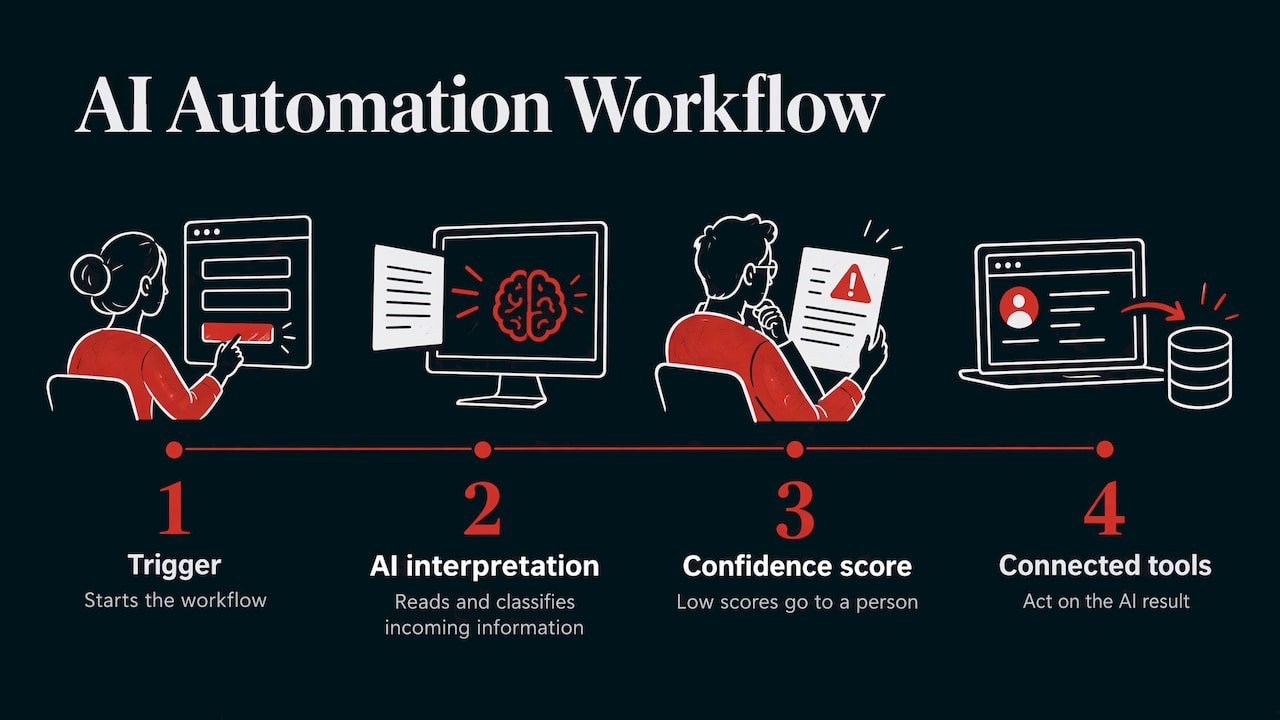
In practice that means a system that can read an enquiry, work out whether it is a booking request, a complaint or a price question, fill in the right record and draft the reply. The routine, repetitive reading and typing between systems is automated. The judgement stays with you.
Rules-based or AI: a quick test
Ask three questions about the process:
- Are the inputs always structured, with the same fields in the same format?
- Is the path through the process fixed?
- Are exceptions rare and easy to define in advance?
If the answer to all three is yes, plain workflow automation is usually enough. If any answer is no, the process involves variable input or judgement, and an AI step earns its place.
Which tasks to automate first
Not every task deserves automation. Harvard Business School Online advises that high-frequency, low-value tasks are the strongest candidates for full automation, while lower-frequency or higher-value work, especially anything involving risk, ethics or customer relationships, is better augmented: AI supplies scale and direction, people keep the decision.
Microsoft’s guidance offers a scoring method you can apply to any task. Rate it on four criteria: how repeatable it is, how much impact it has, how easily an error would be spotted, and how time-sensitive it is. The scores tell you whether to automate with human review, support with AI while a person leads, or keep the task fully human.
Applied to the businesses we work with, the pattern looks like this:
| Business | Good first candidates | Keep with a person |
|---|---|---|
| Law firm | Intake form sorting, appointment scheduling, first-draft follow-up emails | Advice, fee discussions, anything sent to a client as the firm’s position |
| Clinic or dental practice | Booking requests, reminders, enquiry triage by treatment type | Clinical questions, anything involving patient records and consent |
| E-commerce brand | Order status queries, product-question replies, review tagging | Refund exceptions, complaints that escalate |
| B2B or professional services | Lead qualification, CRM updates, meeting summaries | Proposals, pricing, contract terms |
For customer-facing work, our guide on automating customer support without losing customers goes through where the hand-off to a person belongs. For a wider view of the service category, see what workflow automation services cover in the UAE.
Where people stay in charge
The aim is not to remove people. It is to put them where their judgement is worth the most. Microsoft’s guidance says final approvals, high-risk external communication and ambiguous work should remain fully human-led.
IBM makes a related point in its five questions to ask before automating a workflow: a workflow that runs faster does not necessarily produce a better business outcome. Where decisions carry consequences beyond one transaction, a person has to remain in the loop.
A useful way to set the boundary is to think in levels of autonomy rather than automated versus manual:
- Assistive: the AI suggests, a person does the work.
- Supervised: the AI does the work, a person checks every output.
- Conditional: the AI acts alone on high-confidence items and sends the rest for review.
- Autonomous: the AI acts alone within clear limits, with logging.
Most workflows should begin at the first or second level. Move up only after you have measured output quality, how many exceptions occur and how much the review costs you. Payment fields, external messages and final decisions are the last things to hand over.
The UAE government’s own AI adoption guideline treats explainability as a design requirement: document what data the system used and what it considered, so that a result can be explained afterwards. That is a sensible standard for a private business too, especially a law firm or clinic whose clients may ask why something was done.
How to pilot and measure an AI workflow
The businesses that get value from AI treat it as an operations project with a measurable result, not a software purchase. The UAE guideline sets out a staged approach: planning with decision gates, a proof of concept, then a working version, then a final product, each with defined datasets, success criteria and a cost-benefit case set at the start. You can scale that down to a small business in six steps.
- Pick one process. Choose one with high volume, a clear owner and a visible cost, such as enquiry handling or appointment booking.
- Record the baseline. Measure how long the process takes, how many transactions run through it, the error rate and the staff hours involved. Without this, you cannot show improvement later.
- Check your data. Know where the information lives, who owns it and who is allowed to access it. The UAE guideline lists completeness, accuracy, validity, consistency, timeliness and uniqueness as the quality checks.
- Set acceptance criteria before testing. For example: at least a set percentage of enquiries routed correctly, and no unreviewed client-facing messages.
- Run it supervised. Log errors, exceptions, cost and staff feedback for several weeks, with a person approving outputs.
- Compare with the baseline and decide. Widen the scope, adjust it or stop. Stopping a pilot that does not pay back is a sound business decision.
Marketing teams in particular can borrow from this AI content strategy plan, which shows how to test AI output against a defined goal before committing more budget.
Measuring the return honestly
The formula is simple: ROI is total financial benefit minus total cost, divided by total cost, times 100. The hard part is the benefit figure. PwC’s analysis for the UAE argues that faster task execution creates economic value only when the released capacity is redeployed or new revenue is generated. If your coordinator saves ten hours a week and nothing changes, you have a nicer week, not a saving.
Count a benefit only when one of these is true: you avoided a hire, cut overtime, handled more billable work with the same team, or moved staff onto work that brings in revenue. Calculate payback period separately, so you know how long the investment takes to earn back.
What it costs: categories to budget for
Published UAE price ranges for AI projects vary widely, because scope varies widely: a simple enquiry-routing workflow and a multi-system integration are different projects. A more reliable approach is to budget by category. Deloitte’s guide for GCC leaders lists infrastructure, data acquisition and preparation, talent and training, model development and deployment, and ongoing maintenance, and recommends tracking actual costs against budget through the whole project.
Two items are often forgotten: the time your own team spends cleaning data and reviewing outputs, and the monthly cost of keeping the system running and monitored after launch. Include both in the business case from the start.
UAE data rules your automation must respect
Any workflow that reads enquiries, patient details, client files or customer orders processes personal data. The UAE’s Federal Decree-Law No. 45 of 2021 on Personal Data Protection (the PDPL) applies to organisations in the UAE and to those outside it that process the data of people in the UAE. Certain data, such as regulated health, banking and free-zone data, is carved out and falls under its own regimes, so a clinic or a firm in a free zone should confirm which rules govern it.
The law’s core principles shape how you design an AI workflow. Personal data must be processed fairly, transparently and lawfully, collected for a specific and clear purpose, limited to what is necessary, kept accurate, secured against breach and not kept once the purpose is finished.
In practical terms:
- Do not feed more personal data into an automation than the task needs.
- Control who and what can access the data, including third-party tools connected through integrations.
- Keep a record of which data the workflow uses and why.
- Keep a person reviewing outputs that affect individuals.
PwC’s UAE handbook on data privacy and responsible AI treats responsible AI as an extension of PDPL principles. Its nine steps include a use-case and data inventory, privacy impact assessments, privacy by design and vendor privacy checks. Even if you never write them up formally, they work as a checklist before you go live.
Why now: the UAE context
Adoption is moving quickly. According to the State of AI 2026 report, 70.1% of UAE working-age adults used AI tools regularly in the first quarter of 2026, the highest rate in the Microsoft AI Diffusion Report, and 45% of Gulf organisations embed AI in service operations and in marketing and sales. The same report notes that Dubai’s government and private sector were directed in April 2026 to move to agentic AI within two years, and that fewer than one-third of GCC organisations have scaled AI beyond pilots.
That last point matters most. Trying AI is easy. Running a part of your business on it, with a baseline, a review routine and clear ownership, is where the advantage sits.
Our perspective
We build automation around one rule: start from a measured problem, not from a tool. Before any workflow is designed, we want to know how long the process takes today, where it goes wrong and what a better result is worth to you. Our audits are grounded in real data and provided upfront, so the decision to proceed rests on numbers.
Our focus is the UAE. We build around how people in Dubai and Abu Dhabi search, enquire and book, including bilingual behaviour, rather than adapting a global template. That matters for automation because the enquiries, messages and documents an AI reads are exactly where local language and habits show up.
We also think automation and growth belong together. The same agency that connects your enquiry handling to your CRM can look at how visitors reach your site and what turns them into customers, through SEO, GEO, conversion optimisation and paid advertising. Faster handling of leads is worth more when the leads are qualified and the site converts them.
Our reporting is meant to be honest and transparent: you see what the workflow handled, where people stepped in and what changed against the baseline.
the author
Getting started with Foureyes Solutions
If you have a process in mind, such as enquiry triage, booking, lead qualification or support replies, our AI Workflows & Automation service covers it for businesses in the UAE. We combine it with the rest of our digital growth work, from web development to conversion optimisation, so the automation sits inside a system built to bring in and convert customers.
See the AI Workflows & Automation page for what we offer, or contact Foureyes Solutions to talk through your first process.
FAQ
What is the difference between AI automation and traditional automation?
Traditional automation follows fixed rules and suits stable, predictable processes. AI automation interprets variable inputs such as free-text messages or documents, then acts on them. Good systems send low-confidence cases to a person for review.
Which tasks should a small business automate first?
Start with high-frequency, low-risk work: sorting enquiries, scheduling, updating your CRM, drafting routine replies and answering order-status questions. Keep approvals, payments, sensitive communication and final decisions with your team until you have measured the quality of the output.
How do I know whether AI automation is paying off?
Record a baseline before you start: processing time, volume, error rate and staff hours. After the pilot, compare against it. Count a saving only where time was redeployed to revenue-generating work, a hire was avoided or more work was handled by the same team.
Does the UAE data protection law apply to my AI workflows?
If the workflow processes personal data of people in the UAE, the PDPL generally applies, subject to exclusions such as regulated health, banking and free-zone data. Limit the data to what the task needs, secure it and keep a record of its purpose.
Sources
- What Is AI Automation for Business? How It Works (Snowflake)
- AI-Powered Business Process Automation: When to Automate (Harvard Business School Online)
- Decide when Copilot or an agent is the right tool (Microsoft Support)
- Automating a Workflow? 5 Questions to Ask First (IBM)
- AI Adoption Guideline in Government Services (UAE Government)
- From AI momentum to AI returns (PwC UAE)
- A GCC leader’s guide for driving Generative AI adoption (Deloitte)
- Federal Decree-Law No. 45 of 2021 on Personal Data Protection
- Data privacy & responsible AI handbook for the UAE (PwC)
- State of AI 2026 report