To get more organic traffic, work in a fixed order: measure what you already earn, fix the technical issues that hold pages back, improve the pages that nearly rank, then publish new content only where a page has a job to do. For UAE businesses, add Dubai and Abu Dhabi search behaviour, English and Arabic queries, and local signals on top. This guide gives that routine step by step. It is the same approach behind our SEO services in Dubai and Abu Dhabi, where every audit starts from your own data rather than a generic checklist.
TL;DR
- Organic traffic is visits from unpaid search results. Measure it in Google Analytics 4 and Google Search Console, and strip out branded searches to see what SEO itself is earning.
- The fastest gains usually sit in pages already ranking on page two and in pages whose clicks have dropped, not in new articles.
- Fix speed, mobile and crawl issues first, because they cap every other improvement.
- In the UAE, local profile signals, bilingual queries and sector-specific pages (law, clinics, e-commerce, real estate) decide who gets the qualified visits.
- Traffic is a means. Judge each page by the enquiries, bookings or sales it supports.
Table of Contents
- What organic traffic is and how to measure it
- Step 1: Fix the technical ceiling
- Step 2: Find the pages and queries closest to a win
- Step 3: Improve existing pages before publishing new ones
- Step 4: Win local and bilingual visibility in the UAE
- Step 5: Prepare for AI search as well as Google
- Step 6: Turn the extra visits into enquiries and sales
- A realistic 90-day plan
- Our perspective
- Where we can take the work off your hands
- FAQ
- Sources
What organic traffic is and how to measure it
Organic traffic means visits that arrive from unpaid results in a search engine. Paid ads, social posts and email campaigns are counted separately.
In Google Analytics 4, open Reports, then Life cycle, then Acquisition, then Traffic acquisition. Filter the Session default channel group so it exactly matches “Organic Search”. Search Engine Land’s measurement guide describes the same filter and suggests looking at the last 90 days. Add a country segment so you can see how many of those visitors are in the UAE, and how many are not.
Google Search Console shows the other half: the queries and pages behind those visits, with impressions, clicks and average position. Search Console only keeps 16 months of data, so export your figures regularly if you want year-on-year comparisons.
Two habits make the numbers honest:
- Separate branded from non-branded queries. Branded searches (people typing your company name) mostly reflect existing awareness. Growth in non-branded queries is the evidence that SEO is working.
- Record a baseline before you change anything. Note organic sessions, non-branded clicks, and the number of enquiries or orders that come from organic visits. Without it, you cannot tell which change did what.
Step 1: Fix the technical ceiling
A page that loads slowly, breaks on a phone or cannot be crawled will struggle whatever its content. This is also the step where results are most predictable, so do it first.
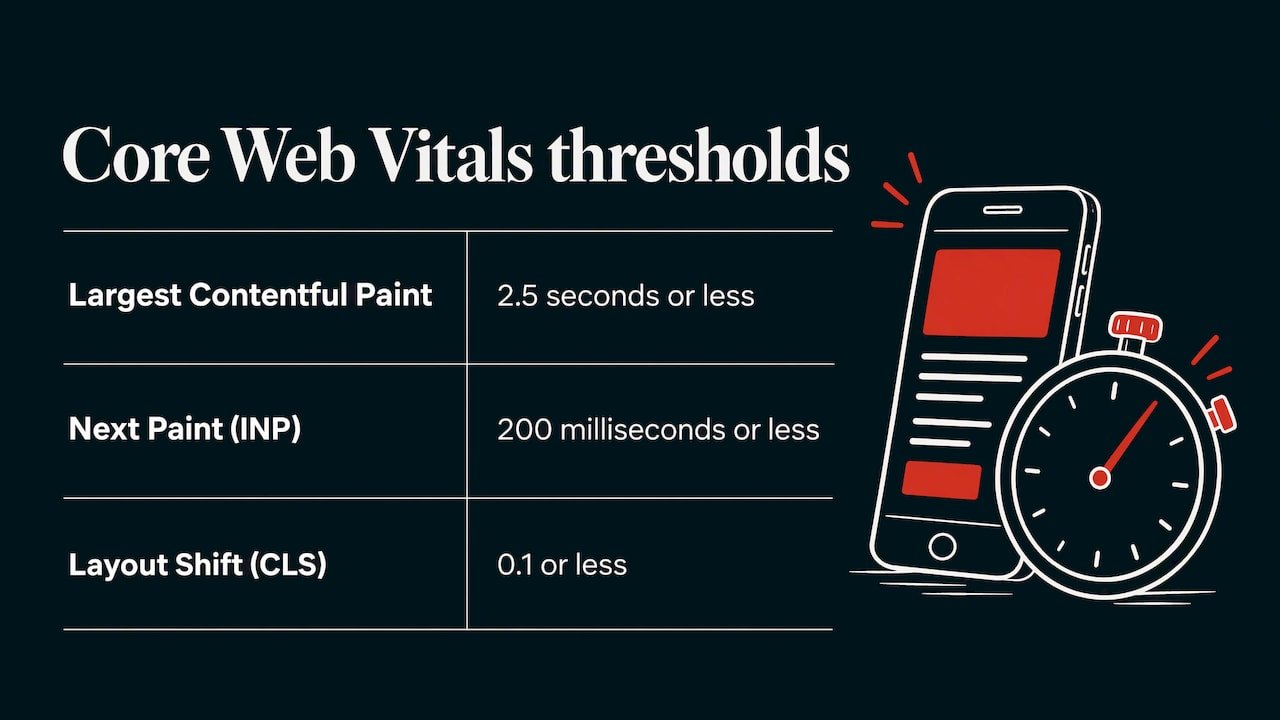
Speed and page experience. Google publishes the thresholds for its Core Web Vitals: a good Largest Contentful Paint is 2.5 seconds or less, a good Interaction to Next Paint is 200 milliseconds or less, and a good Cumulative Layout Shift is 0.1 or less, according to Google’s web.dev guidance. Check them in Search Console’s Core Web Vitals report, which groups URLs by status so you can see which templates need work rather than testing page by page.
Mobile. Most UAE users browse on phones, and Google indexes the mobile version of your pages. Check that menus, forms and click-to-call buttons work on a small screen, and that the content on mobile matches the desktop version.
Crawling and indexing. In Search Console, review the Pages report for URLs that are excluded and ask why. Typical causes are accidental noindex tags, duplicate versions of the same page, broken redirects and thin filter pages on online shops. English and Arabic versions of a page should be linked to each other with hreflang annotations so the right language is shown to the right searcher.
Where it goes wrong: teams often chase a perfect speed score on one page while the real problem is a template shared by hundreds. Fix the template, then re-measure. Our guide to technical SEO services and when to hire help explains what a technical review covers and how to tell which issues are worth the development time.
Step 2: Find the pages and queries closest to a win
Before you write anything new, look at what Google already thinks your site is relevant for.
- In Search Console, open the Performance report and filter for average positions 11 to 20. These pages sit on the second page, where very few people click. A better title, clearer headings, more complete answers and a few internal links can move them onto page one.
- Compare the last three months with the previous three. Sort by clicks lost. A page that dropped is usually a page that has gone out of date, been overtaken by a fresher competitor or started to overlap with another page on your own site.
- List the queries with many impressions and a low click-through rate. The page is visible but the title and description do not earn the click.
When you judge new keyword ideas, do not stop at the search volume. The page that ranks first for a term typically also ranks for dozens of related queries, so the useful question is how much traffic that top page earns in total. Volume alone overstates what any one ranking brings: even a first-place result does not capture every search for the term.
For a UAE business, add a language check. Many buyers search in Arabic, in English, or switch between the two within one session. A law firm in Dubai, for example, may be searched for in English by expatriate clients and in Arabic by local ones, and the intent, wording and competing pages differ. Treat each as its own research list rather than translating one.
Step 3: Improve existing pages before publishing new ones
Refreshing is cheaper than starting from nothing and often faster. For each page that lost clicks or sits on page two:
- Update the facts. Replace out-of-date figures, fees, regulations and screenshots. Add the year only where it genuinely matters.
- Match the intent. Informational searches want a guide, commercial searches want a comparison, and transactional searches want a product or service page. If the wrong page type is trying to rank, no amount of keyword work will fix it.
- Reword headings around the queries that dropped. Search Console shows the exact queries; answer them directly under their own heading.
- Merge overlapping pages. Two thin pages on the same topic compete with each other. Combine them into one stronger page and redirect the old address to it.
- Retire what earns nothing. A page with no traffic, no links and no business purpose can be redirected or removed.
Once the existing pages are in order, build new content around topic clusters: one comprehensive pillar page on a core subject, with narrower pages answering specific questions and linking back to it. This structure helps visitors move naturally from a general question to a decision, and it gives search engines a clear picture of what your site covers.
Make every page earn its place
More pages do not automatically mean more value. Search Engine Land’s October 2026 argument for making every page count makes a point worth acting on: a page with modest traffic that supports a later purchase decision can be worth more than a high-traffic page that attracts casual readers. The same guide on measurement also notes that moving from position 7 to position 5 may not change traffic much, so effort should go where a ranking change is likely to matter.
Practically, give every page a role before it is written: attract, compare or convert. Pages that help someone decide, such as case studies, service explainers and comparison pages, often benefit from formats beyond text. Personalised and localised video content is one way to present a product to different language audiences while the page itself stays focused on the purchase decision.
Step 4: Win local and bilingual visibility in the UAE
Much of the demand in the UAE is local: “dentist near me”, “commercial lawyer in Business Bay”, “furniture delivery Abu Dhabi”. For these searches the map results and the business profile matter as much as the website.
Google states that local results are ranked mainly on relevance, distance and prominence, as set out in its Business Profile help page on improving local ranking. In practice:
- Relevance: choose accurate primary and secondary categories, list every service, and write the description in the language your customers use.
- Distance: you cannot move your office, but you can create pages for the emirates and districts you really serve, with real content about them rather than copied text with the place name swapped.
- Prominence: reviews, mentions and links from respected local sites. Ask satisfied customers for reviews in a way that is easy for them, and reply to each one.
Keep your name, address and phone number identical across your website, profile and directories. For links, aim for relevance over volume: industry associations, local press, supplier and partner pages, and genuinely useful resources that others cite. Bought links in bulk are a risk, not a shortcut.
Sector matters too. A dental clinic needs treatment pages, dentist profiles and booking paths; our overview of dental SEO services in the UAE shows how those pieces fit. Law firms, e-commerce brands, real estate agencies and professional services each have different intent patterns, which is why generic templates underperform.
Step 5: Prepare for AI search as well as Google
More people now get answers from AI-generated summaries and assistants before they ever click a result. Generative Engine Optimisation (GEO) is the practice of making your content easy for those systems to understand, trust and cite: clear answers, accurate facts, consistent business information and well-structured pages. The groundwork overlaps with good SEO, so the same refreshed pages serve both. If you want to know whether this applies to your business now, read 5 signs your Dubai business needs GEO optimisation, or see our Generative Engine Optimisation service.
Step 6: Turn the extra visits into enquiries and sales
More visitors only help if more of them act. Once traffic grows, look at what happens after the click:
- E-commerce: product pages with clear images, delivery and returns information, reviews and a short path to checkout. Shopify and WooCommerce stores often lose sales in the cart and checkout steps rather than on the product page.
- Law firms and clinics: a prominent phone number and booking form, treatment or practice-area pages that answer the questions people ask before they commit, and proof such as credentials and patient or client reviews where appropriate.
- B2B and professional services: a single clear next step per page, and a form that asks only for what you need.
This is the work of Conversion Rate Optimisation (CRO): reviewing the page against known usability principles (a heuristic audit), then running A/B tests, where two versions of a page are shown to different visitors and the results are compared. A test needs enough visits to reach statistical significance, meaning the difference is unlikely to be chance. Growing organic traffic is what makes that testing possible on more pages. Our Conversion Rate Optimisation work focuses on exactly this stage.
A realistic 90-day plan
| Period | Focus | What you should have at the end |
|---|---|---|
| Weeks 1 to 2 | Baseline and audit | Organic sessions, non-branded clicks and organic enquiries recorded; technical issues listed by template |
| Weeks 3 to 6 | Technical fixes and quick wins | Core Web Vitals problems on key templates addressed; titles and headings improved on page-two and low-CTR pages |
| Weeks 7 to 10 | Refresh and consolidate | Declining pages updated, overlapping pages merged and redirected |
| Weeks 11 to 13 | Local signals and new content | Profile and review routine in place; first cluster pages published with a defined role |
SEO compounds over months, so treat the first quarter as laying the foundations and review the trend in non-branded clicks rather than a single week’s figure. Budget is a common question; see our notes on SEO pricing in the UAE and use the SEO budget estimator to shape a range for your site.
Our perspective
We build every campaign around how people in Dubai and Abu Dhabi actually search: in English and in Arabic, from a phone, often with a local need. That is why we do not start with a list of tactics. We start with an audit grounded in your own data, provided upfront, so you can see where the traffic is being lost before any work begins.
Our view is that organic traffic is only worth growing when it is qualified. A law firm needs consultations, a clinic needs appointments and a Shopify store needs orders. That is why we combine SEO, GEO and conversion optimisation in one approach: technical expertise to make the site discoverable, customer behaviour analysis to understand what visitors want, and continuous optimisation to keep improving both.
We report honestly and transparently. If a change moved non-branded clicks, you will see it. If a page is not earning its place, we will say so and fix it.
the author
Where we can take the work off your hands
If you would rather not run this routine yourself, our team handles it across the areas that decide organic growth: SEO for rankings and technical health, GEO for AI search visibility, web development on WordPress, Shopify and WooCommerce, and CRO to turn the visits into customers.
We work with e-commerce brands, law firms, clinics and professional services in the UAE and internationally. Start with an audit from Foureyes Solutions and see where your next gains are.
FAQ
How long does it take to increase organic traffic?
Technical fixes and improvements to pages already ranking on page two can show in Search Console within weeks, once Google has recrawled the pages. New content and local authority usually take several months to build. Track non-branded clicks over at least a quarter before judging results.
Is organic traffic the same as SEO traffic?
Organic traffic is the visits; SEO is the work that grows them. In Google Analytics 4 it appears as the Organic Search channel. Visits from paid ads, social media and email are reported in their own channels.
Should I publish more content or improve existing pages?
Start with existing pages. Refreshing pages that lost clicks, merging overlapping ones and improving page-two rankings usually costs less and pays back sooner. Publish new pages when you have found a topic or intent your site does not yet answer, and give each a clear role.
Does Arabic content matter for UAE organic traffic?
Yes, where your customers search in Arabic. Queries, wording and competing pages differ by language, so build separate keyword research and properly linked language versions rather than a straight translation.
Do I need to worry about AI search?
It is worth planning for. Clear, accurate, well-structured pages with consistent business information help both traditional results and AI-generated answers, so the improvements in this guide serve both.
Sources
- How to measure SEO performance and results, Search Engine Land
- Make every page count before publishing more for SEO, Search Engine Land
- Web Vitals, web.dev
- Improve your local ranking on Google, Google Business Profile Help
- Personalised and localised video content